Home Page Overview Site Map Index Appendix Illustration About Contact Update FAQ


Atoms


Contents

Periodic Table
Band Theory, Metal
Specific Heats of Solids and Phonons
Superconductivity
Laser
Plasma
Nano-science
Quantum Computing (see appendix)
Footnotes
References
Index

Periodic Table

In the mid 19th century, scientists were confronted with a mountain of seemingly unconnected chemical data - a situation similar to the particle physics in mid 20th century. In 1869 the Russian chemist Mendeleyev successfully organized the various chemical elements into a Periodic Table. Similar elements are arranged in vertical columns and the properties of the elements change progressively across the row.
Periodic Table 1 Periodic Table 2 The Periodic Table in Figure 13-01a is the modern version; while Figure 12-19 depicts the simpler one. The atomic number is the number of positive charges in the atomic nucleus. Atomic masses refer to the masses of neutral atoms, including the masses of the electrons and the mass equivalent of their binding energies. It is expressed in mass units such that the mass of the most abundant type of carbon is exactly 12.00 u

Figure 13-01a Periodic Table,
Modern [view large image, 1 MB]

Figure 13-01b Periodic Table,
Unconventional [view large image]

(1 u = 1.66x10⁻²⁴ gm).
Also see "Extension of the Periodic Table".

It was discovered later that not all of the atoms of a particular element have the same mass. The different varieties (different number of neutrons, same number of protons) of the same element are called its isotopes. The atomic masses now appear in
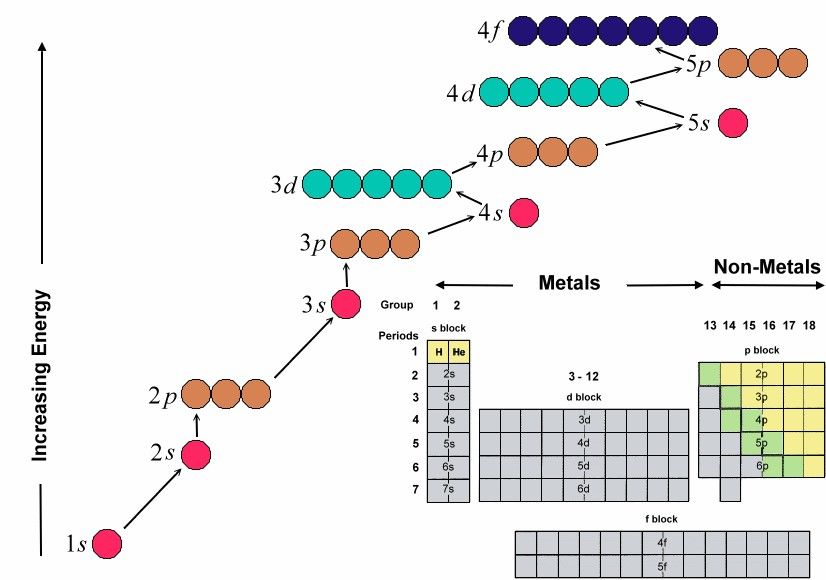
Periodic Table, Comical the Periodic Table is the average atomic mass (weighted by the abundance of each isotope). Figure 13-01a includes data for the boiling point, melting point, density, acidity, basicity, crystal structure, and electronegativity (tendency to keep electrons) of the elements. The s, p, d, and f letters in the electronic configuration designate the orbital quantum number l = 0, 1, 2, 3, ... respectively for the outer shell electrons. A new designation of the groups has a number ranged from 1 to 18. Figure 13-01b is an unconventional Periodic Table. It specifies the phase (solid, liquid, or gas) of the element at room temperature, whether the element is radioactive or man-made, as well as its usage (in daily life) or occurrence (in nature). The original version in pdf format, and other Periodic Table in words are available from this link: http://elements.wlonk.com. Other kinds of

Figure 13-01c Periodic Table, Comical [view large image]

Periodic Table may incorporate properties such as atomic radius, covalent radius, ionization potential, specific heat, heat of vaporization, heat of fusion, electrical conductivity, and thermal conductivity etc. Only a few of the elements are edible as shown in Figure 13-01c.

The regular pattern in the periodic table is related to the states of the electrons in an atom. It is specified by four quantum numbers. The principal quantum number n determines the energy level; its value runs from 1, 2, 3, ... For each n, the orbital quantum number l = 0, 1, 2, ... (n-1); it is related to the magnitude of angular momentum. Then for each l, the magnetic quantum number m can be -l, -l+1, ...l-1, l; it is related to the z component of the angular momentum. The spin quantum number s is either +1/2 or -1/2.

For n = 1, l = 0, m = 0, there is only 2 possible quantum states for the electron, with s = +1/2 and -1/2 respectively. For n = 2, l = 0, m = 0 and l =1, m = -1, 0, +1; there is a total of 2 + 6 = 8 possible quantum states. Therefore, it requires 2 electrons to complete the shell for n = 1, and 8 electrons to complete the shell for n = 2, ...and so on. The orbital quantum number l is often designated by a letter, s for l = 0, p for l = 1, d for l = 2, and f for l = 3 ...

The quantum number l is non-additive (e.g., two of the quantum numbers l1, l2 are added as vectors, they can take on the values of l1+l2, l1+l2-1, ..., |l1-l2| ) while m is additive (e.g., m' = m1 + m2 only) and relates to an Abelian group (e.g., the two dimensional rotation about the z-axis). States having the same non-additive quantum numbers but differing from each other by their additive quantum numbers are said to belong to the same multiplet. The number of members of a multiplet is called its multiplicity. For a given multiplet l the multiplictiy is equal to 2l+1.

The atom tends to lost the outer electrons if the number is far from a complete shell or sub-shell such as the elements in the beginning of a series. It gradually develops a preference for accepting more electrons to complete the outer shell as the progression moves toward the end of a series. This property is responsible for all the chemical reactions, which form molecules with a tendency of completing the shell (energy levels with similar energy, usually with the same value of n) or subshell (energy levels having almost the same energy, usually with the same values of l). A stable atomic configuration is also achieved by completing a shell or sub-shell as illustrated in Table 13-01 below by the inert elements (the rule becomes more complicated in the advanced series as the electrons with high l tend to intermingle with each others), which do not react chemically:

n ..., l ..., (2l+1)x2 Electron Configuration of the Inert Element
1 0 2 He (2)=2
2 0, 1 2, 6 Ne (2)+(2+6)=10
3 0, 1, 2 2, 6, 10 Ar (2)+(2+6)+(2+6)=18
4 0, 1, 2, 3 2, 6, 10, 14 Kr (2)+(2+6)+(2+6+10)+(2+6)=36
5 0, 1, 2, 3, 4 2, 6, 10, 14, 18 Xe (2)+(2+6)+(2+6+10)+(2+6+10)+(2+6)=54
6 0, 1, 2, 3, 4, 5 2, 6, 10, 14, 18, 22 Rn (2)+(2+6)+(2+6+10)+(2+6+10+14)+(2+6+10)+(2+6)=86

Table 13-01 Electron Configuration of the Inert Elements

Note: Small inserts in the 2nd column depict the corresponding atomic structures with the semi-classical view in term of orbital motion, and quantum view in term of probability density.

[Top]


Band Theory, Metal

Energy Bands Band Theory About 80% of the free elements at room temperature exists in the form of metal. The conditions to form metal are vacant valence orbitals and low ionization energies. Similar to the splitting of energy levels when two or more atoms come close to each other; (See Figure 12-15.) energy levels broadened to a band (many closely spaced energy levels)

Figure 13-03 Energy Bands
[view large image]

Figure 13-04 Band Theory
[view large image]

for an aggregate of many atoms as shown in


Figure 13-03. In this example, the valence electrons occupy the energy bands up to half of the 3s band at 0oK, at an energy called Fermi energy Ef. Figure 13-04 shows that if there is empty levels available in the energy band, valence electrons will be able to roam among the space in between the atoms by absorbing energy from the environment when the temperature is above 0oK. With a few exceptions, metals have a silvery-white color because they reflect all frequencies of light. They have high electrical and thermal conductivity and all metals can be drawn into wires or hammered into sheets without shattering -- that is, they are ductile and malleable. All these attributes are the result of mobile, non-rigid electron gas within the lattice. Most metals (except gold, silver, platinum, and diamond) do not occur as free elements in the Earth's crust. They are usually found in chemical combination with other elements as mineral ores.

Figure 13-04 shows that in an insulator, the valence band is full and the next empty energy band is separated by a large energy gap. Conduction cannot occur unless some of the electrons in the valence band are promoted to the conduction band. Energy needed to promote a few electrons might be provided by heating the solid to a very high temperature or by shining X rays on it. No solid can remain as a good insulator while it is exposed to X rays. A semicon-ductor has a small energy gap. Electrons can be promoted to the conduction band as a result of irradiation such as the conversion of sunlight to electricity by means of a silicon cell.

[Top]


Specific Heats of Solids and Phonons

Beside the metallic bond, atoms and their compounds can form crystal by other types of bond as shown in Figure 13-05. It is expected that vibrations of the constituent atoms would determine the physical properties of the crystal (solid). For example, the specific heat cv, which is the energy that must be added to raise the temperature by 1oC (at constant volume) in one kmole of the substance, would have a value of about 3R (where R is the gas constant equal to 1.99 kcal/kmole-oK). This is indeed the case for most solids at room temperature and above as shown in Figure 13-06. However, it failed to account for the drip at low temperature. In 1907 Eistein derived an improved theoretical formula by considering the vibration to be quantized in multiples of hv, where v is the frequency of the vibration. The idea is similar to the quantized electromagnetic wave in blackbody radiation. But it still failed to describe the behavior of the specific heat at very low temperature. The discrepancy is finally resolved in 1912 by considering a solid as a continuous elastic body. Instead of residing in the vibrations of individual atoms, the internal energy of a solid is assumed to reside in elastic standing waves.
Crystal Types Specific Heats These waves, like electromagnetic waves in a cavity, have quantized energy contents. A quantum of vibrational energy in a solid is called a "phonon", and it travels with the speed of sound. The concept of phonones is quite general and has applications in connection with the thermal conductivity of some solids, the way electrons in the crystal structure interact with sound waves, and in superconductivity.

Figure 13-05 Crystal Types [view large image]

Figure 13-06 Specific Heats
[view large image]

[Top]


Superconductivity

Superconducting Elements If mercury is cooled below 4.1 K, it loses all electric resistance. This discovery of superconductivity by H. Kammerlingh Onnes in 1911 was followed by the observation of other metals and intermetallic compounds (made of two or more metallic elements) which exhibit zero resistivity below a certain critical temperature Tc. The fact that the resistance is zero has been demonstrated by sustaining currents in superconducting lead rings for many years with no measurable reduction. Table 13-02 shows the elements, which can become superconducting at the indicated critical temperature.

[view large image]

Table 13-02 Super-conducting Elements

Superconducting Compounds Ceramic materials are expected to be insulators -- certainly not superconductors, but that is just what Georg Bednorz and Alex Muller found when they studied the conductivity of a lanthanum-strontium-copper oxide ceramic in 1986. Its critical temperature of 30 K was the highest, which had been measured to date. Their discovery started a surge of activity which discovered superconducting behavior as high as 125 K. However, these compounds are hard to make and difficult to shape. They pose a multitude of physical challenges to researchers and engineers.

Figure 13-07 High Temperature Superconductors [view large image]

Figure 13-07 lists the high temperature (above 4o K) superconductors discovered during the last one hundred years.

Superconductivity Meissner Effect

The effect of superconducting is often demonstrated by cooling a disk made of superconducting material with liquid nitrogen to below the critical temperature Tc. A magnet placed above the disk is repelled, i.e., it is levitated above the superconductor. (See Figure 13-08a.) This phenomenon is caused by the Meissner effect which is related to the fact that a superconductor will exclude magnetic fields within the superconducting material

Figure 13-08a Superconductivity

Figure 13-08b Meissner Effect

(see Figure 13-08b).

Suppose, as in Figure 13-08a, a magnet is placed above a superconductor. The induced magnetic field inside the superconductor is exactly equal and opposite in direction to the applied magnetic field, so that they cancel within the superconductor. The result are two magnets equal in strength with poles of the same type facing each other. These poles will repel each other, and the force of repulsion is enough to float the magnet. However, the magnet's magnetic field must be below the superconductor's critical magnetic field Hc. If the magnetic field is stronger than Hc it would penetrate the superconductor and extinguish the superconductivity.

In 1956 L. Cooper offered an explanation for this phenomenon of superconductivity. The process starts in some materials at very low temperature when two electrons near the Fermi energy level could couple to form an effective new particle, under a
Cooper Pair very weak attractive force. This particle was subsequently called the Cooper pair (Figure 13-08c). It can be shown that the most energetically favourable situation for this to occur was when the two electrons had a total spin of zero. Since the Exclusion principle does not apply to particle with integer spin, there is no restriction on the energy state that the Cooper pair can occupy. In particular, at low temperatures thermal agitation is minimal, and all of the Cooper pairs can occupy the lowest possible energy state. Thus no energy exchanges can take place (nothing to give), the normal resistive energy losses are not

Figure 13-08c Cooper Pair [view large image]

possible. The Cooper pairs move unimpeded through the superconducting material: it has zero electrical resistance and exhibits superconductivity. The weak attractive force between the electrons in the Cooper pair has its origin in the induced polarization (of the
atoms in the lattice, see Figure 13-08c). An equivalent description is to consider the attraction as the result of the emission of a virtual phonon by one electron and its absorption by another one as shown by the Feynman diagram in Figure 13-08c.

This is known as the BCS theory. It does not explain the absence of resistance in copper oxide based compounds. There is still no definitive theory of how or why these compounds become superconductivity.

It has been shown that the exclusion of magnetic flux (Meissner effect) corresponds to a finite range for the electromagnetic field and hence to a `massive photon'. In the context of quantum field theory, the meissner effect in a superconductor occurs because the U(1) gauge symmetry is broken in a superconductor. The photon acquires a mass through the Higgs mechanism and the Higgs bosons are the Cooper pairs.

Superconductivity is often cited as an example of emergent phenomenon when novel property appears in an ensemble of individual parts. The human brain is another example where ensemble of molecules and atoms becomes a conscious whole.

[Top]


Laser

Laser, Ruby Laser, Energy Levels Finding substances in which a population inversion can be set up is central to the development of new kinds of laser. The first material used was synthetic ruby. Ruby is crystalline aluminum (Al2O3) in which a small fraction of the Al3+ ions have been replaced by chromium ions, Cr3+. It is the chromium ions that give rise to the characteristic pink or red colour of ruby and it is in these ions that a population inversion is set up in a ruby laser.

Figure 13-09 Ruby Laser
[view large image]

Figure 13-10 Laser, Energy
Levels [view large image]

In a ruby laser, a rod of ruby is irradiated with the intense flash of light from xenon-filled flashtubes. (See Figure 13-09.) Light in the green and blue regions of the spectrum is absorbed by chromium ions, raising the energy of electrons of the ions from the ground state level to the broad F bands (See Figure 13-10). Electrons in the F bands rapidly undergo non-radiative transitions to the two metastable E levels. A non-radiative transition does not result in the emission of light; the energy released in the transition is dissipated as heat in the ruby crystal. The metastable levels are unusual in that they have a relatively long lifetime of about 4 milliseconds (4 x 10⁻³ s), the major decay process being a transition from the metastable level to the ground state. This long lifetime allows a high proportion (more than a half) of the chromium ions to build up in the metastable levels so that a population inversion is set up between these levels and the ground state level. This population inversion is the condition required for stimulated emission to overcome absorption and so give rise to the amplification of light. Since photons are bosons, which do not obey the Pauli exclusion principle, they can occupy the same state. The stimluating photon and the stimulated photon leave the atom in the same direction, same frequency, same polarization and in phase. This light can then interact with other chromium ions that are in the metastable levels causing them to repeat the same process. As each stimulating photon leads to the emission of two photons, the intensity of the light emitted will build up quickly. This cascade process in which photons emitted from excited chromium ions cause stimulated emission from other excited ion, will create a very intense and coherent red light beam of wavelengths 694.3 and 692.7 nm.

Laser Cooling Laser cooling utilizes the collective momentum of many photons to reduce the thermal motion of an atom. Since the approaching and recessing speed of the atoms differs slightly due to the Doppler effect and the atoms can only absorb a certain frequency, the laser beam can be tuned such that it slows down only the approaching atoms. The six crossed laser beams shown in Figure 13-10a create a space in which atoms moving in this region (the bright area in the center of the picture) are trapped and cooled by absorption of photons from the crossed beams. With this technique, researchers have already reached temperatures lower than a millionth of a degree Kelvin. That's an average atomic speed on the order of a few cm/sec.

Figure 13-10a Laser Cooling

[Top]


Plasma

Phases, the Three Fourth Phase In the solid state, the atoms are firmly imprisoned inside a rigid network (like ice for example). When we raise the temperature, they go into a liquid state (the ice melts), where the atoms may slide around in relation to the others, thus enabling a liquid to adapt to the shape of a container. If we heat it up even more, we arrive at the gas state: atoms then move around freely and independently of each other (water turns into steam). (See Figure 13-11.) Finally, when we get to very high temperatures (typically several million degrees), the ingredients of the atom separate, nuclei and electrons move around independently and form

Figure 13-11 The Three Phases
[view large image]

Figure 13-12 The Fourth
Phase [view large image]

a globally neutral mixture: this is the plasma state (See Figure 13-12).

This fourth state of matter, found in the stars and the interstellar environment, makes up most of our universe (around 99 %). On Earth, it does not exist in a natural form, apart in lightning and the Aurora Borealis. In our everyday life, plasmas have many applications (micro-electronics, television flat screens and so on), of which the commonest is the neon tube. (See Figure 13-13.)

Depending on the temperature, the atoms may be partially or wholly ionized. A plasma may thus be considered as a mixture of positively charged ions and negatively charged
electrons, possibly co-existing with neutral atoms and molecules. For example, in our luminescent tube, the ions and electrons is a small proportion in relation to atoms and molecules. On the other hand, in plasmas produced for fusion experiments, the gas is strongly ionised, and the atoms and molecules are in low proportion, even completely absent in the heart of the pulse. In both cases, the description of plasmas comes from the physics of fluid mechanics and controlled by the force of electromagnetic interaction. The system is described by the usual macroscopic features such as density, temperature, pressure and rate of flow.
Plasma Fusion The vast power radiated by the Sun is generated by the fusion process wherein light atoms combine with an accompanying release of energy. In nature, proper conditions for fusion occur only in the interior of stars. Researchers are attempting to produce the conditions that will permit fusion to take place on earth.

Since nuclei carry positive charges, they normally repel one another. The higher the temperature, the faster the atoms or nuclei move. When they collide at these high speeds, they overcome the force of repulsion of the positive charges, and the nuclei fuse.

Figure 13-13 Plasma Occurrence
[view large image]

Figure 13-14a Plasma Confinement [large image]

In such collisions, energy is released. The difficulty in producing fusion energy has been to develop a

device which can heat the deuterium-tritium1 fuel to a sufficiently high temperature and then confine it for a long enough time so that more energy is released through fusion reactions than is used for heating.

In order to release energy at a level of practical use for production of electricity, the gaseous deuterium-tritium fuel must be heated to about 100 million degrees Celsius. This temperature is more than six times hotter than the interior of the sun, which is estimated to be 15 million degrees Celsius. Scientists have already passed the task of achieving the necessary temperatures. In some cases, they have attained temperatures as high as 510 million degrees, more than 20 times the temperature at the center of the sun.

The problem is how to confine the deuterium and tritium under such extreme conditions. A part of the solution to this problem lies in the fact that, at the high temperatures required, all the electrons of light atoms become separated from the nuclei. The fuel is in a plasma state. Because of the electric charges carried by electrons and ions, a plasma can, in principle be confined by a magnetic field. In the absence of a magnetic field, the charged particles in a plasma move in straight lines and random directions. Since nothing restricts their motion the charged particles can strike the walls of a containing vessel, thereby cooling the plasma and inhibiting fusion reactions. In a tokamak, the high-temperature plasma are confined by the magnetic field around the doughnut-shaped nuclear reactor. As shown by Figure 13-14a, the magnetic fields that confine the plasma are provided primarily by cylinderical magnetics (toroidal magnetic field) and an internal plasma current (poloidal magnetic field).

Combining the toroidal and poloidal magnetic fields creates a helical field that contains the plasma.

However, long-lived pinched plasmas are extremely difficult to maintain. The plasma column is observed to break up rapidly. The reason for the disintegration of the column is the growth of instabilities. The column is unstable against various departures from cylindrical geometry. Small distortions are amplified rapidly and destroy the column in a very short time. The mechanisms of instability in plasma physics are nearly unlimited. Some instabilities are comparable to examples borrowed from fluid mechanics, as the Rayleigh Taylor’s instability, which consists of superposing two fluids with the heaviest on top. Imagine for example a vessel in which you pour water and then carefully add oil over the top. The system is then in a state of meta-stable equilibrium. The slightest nudge will provoke a change with the heavier fluid dropping to the bottom, which corresponds to a stable equilibrium. Another type of instability are kink instabilities, which occur when a current parallel to the magnetic field cause twisting of the field lines, recalling the effect obtained if we twist a rope too much: the rope twists out and kinks. The sausage or neck instability causes a greater inwards pressure at the neck of a constriction. This serves to enhance the existing distortion.

The Tokamak Fusion Test Reactor has produced significant quantities of fusion power (up to 10 Million Watts) from the fusion of DT (Deuterium and Tritium). However, this has not yet reached the breakeven point when output power equals to the input.


EASTIn September 2006, Chinese researchers had, for the first time, managed to inject a plasma of ionized hydrogen into the Experimental Advanced Superconducting Tokamak (EAST, Figure 13-14b), and the plasma sustained currents of 250,000 amps for up to 3 seconds. But no attempt was made to introduce deuterium or tritium into the plasma, so no fusion has taken place. Eventually, the EAST team aims to hold a plasma for study for as long as 1000 seconds. Conventional experimental fusion machines use copper coils, or a combination of copper and superconducting coils, to trap the hot plasma. But copper coils heat up and need to be cooled down regularly, thus limiting operating time. EAST has only

Figure 13-14b EAST
[view large image]

superconducting coils so it can be operated continuously. This US$25-million machine sets the stage for the multibillion-dollar ITER fusion experiment that is to be built in France, and starts operation in 2016.


ITER (Figure 13-14c) is an international project involving The People's Republic of China, the European Union and Switzerland (represented by Euratom), Japan, the Republic of Korea, the Russian Federation, and the United States of America. It is the experimental step between today’s studies of plasma physics and tomorrow's electricity-producing fusion power plants. The location of the reactor has been selected in Cadarache, southern France. The US$5.5 billion funding from
ITER ITER's six international partners could be in place by the winter of 2005, allowing construction to begin in 2006, and operation in 2016. ITER is designed to heat hydrogen to hundreds of millions of degrees centigrade, and then squeeze energy from the resulting plasma, while holding it stable for minutes at a time. It is based on the tokamak model, which up until today has only one machine that has begun to approach the "break-even point". It is believed that by building a tokamak with bigger size, it will allow the high-temperature high-pressure plasma to remain stable longer (~ 7-10 minutes) producing 500 megawatts of energy within the interval.

Figure 13-14c ITER
[view large image]


By 2009 the ITER project faced with ballooning costs and growing delays, its seven partners are likely to build only a skeletal version of the device at first. This mini-ITER should be able to run in 2018. The full-scale version would not come alive until the end of 2025.

[Top]


Nano-science

Traditionally, systems of interest to physicists have been divided into the macroscopic and the microscopic realms, where the latter implies atomic and molecular sizes or smaller. Recently, research in the intermediate (mesoscopic) domain has achieved
Nano Domain significant scientific successes. This field is characterized by the need to use the microscopic laws of quantum mechanics, while, on the other hand, the samples can be made and operated by essentially ordinary macroscopic methods. This involves linear size scales from a few to thousands of atoms, and reliable fabrication and analysis methods exist down to the scale of about fifty atoms. The term "nano" usually denotes the low end of this range. Figure 13-23 shows (left) scale of 10 micron with a circuit board element

Figure 13-23 Nano Domain
[view large image]

comparing to a human hair, and (right) 0.1 micron, where a small stat-of-the-art transistor is compared with one commercially available in 2001.

STM Methods based on extremely powerful scanning tunneling microscope (STM, Figure 13-24) that allows control of both fabrication and analysis on the scale of single atoms are being developed. Controlling man-made molecular structures on the level of individual atoms (including position and orientation) is possible in principle, and physical measurements such as that of the local (atomic scale) density of electronic states near an appropriate defect in a superconductor have been made. A variety of surface probes can measure, for example, the local electrostatic potential on a sample's surface with a resolution approaching 10 nm.

Figure 13-24 STM [view large image]

MBE There are two distinct approaches to manufacture small-scale devices. Microelectronics starts with a large system and then divides it, reducing its dimensions by a variety of well-controlled methods. For example, shapes are printed onto the surface of silicon, which is then etched away to make microscopic wheels or micromotors. The smallest feature capability that can be achieved, appear to be around the 10 nm scale. Other methods work with individual atoms to make even smaller objects. An example of such large-scale preparation of high-quality materials is provided by the MBE (molecular-beam-epitaxy) method (Figure 13-25), which can be used to grow individual lattice layers and extra-thin metallic layers.

Figure 13-25 MBE
[view large image]

Note: The RHEED (Reflection High Energy Electron Diffraction) in Figure 13-25 involves a high energy beam (3-100keV) directed at the sample surface at a grazing angle. The electrons are diffracted by the crystal structure of the sample and then impinge on a phosphor screen mounted opposite to the electron gun. It is used to examine patterns on a surface.

Nanotube The graphite phase of carbon provides some interesting nano materials such as carbon nanotubes and buckyballs (Figrure 13-26). Nanotubes are produced by rolling a layer of two-dimensional graphite, called graphene, into a hollow cylinder parallel to the z axis and having a nanmeter-scale diameter. Graphene is a poor conductor, but the nanotube becomes metallic or semiconducting depending on the details of how exactly the graphene sheet is wound and connected to itself. Spherical fullerene (buckyball) contains 60 or 70 carbon atoms in the soccerball-like crystal of about 1 nm across. As of the early 21st century, the chemical and physical properties of fullerenes are still under heavy study. Fullerenes are not very reactive due to the stability of the graphite-like bonds, and are also sparingly soluble in many solvents. The buckyball has been used to run tests on determining the boundary between classical and quantum domains since its size is close to the transitional zone. Scientists are also working on building very small structures such as the nanorobot (Figure 13-26), which can check out a patient's blood cells. The

Figure 13-26 Nano Objects
[view large image]

microgears were made by etching silicon in the same way as a microchip. Sixty of them would fit on the head of a pin.

[Top]


Quantum Computing (see appendix)

[Top]


Footnotes

1Deuterium and tritium are the isotopes of hydrogen. While the hydrogen nucleus contains only 1 proton, the deuterium contains 1 proton and 1 neutron, and the tritium contains 1 proton and 2 neutrons.

[Top]


[Top]


Index

Atomic mass
Atomic number
Band theory, metal
Bell state measurement
Bell states
Carbon
Conduction band
Cooper pair
Deuterium-tritium fuel
Einstein-Podolsky-Rosen (EPR) source
Entanglement
Fermi energy
Fourier series
Fusion
Glass
Instabilities
Insulator
Isotopes
Laser
Laser Cooling
Meisser effect
Metastable levels
Periodic table
Phonon
Plasma
Population inversion
Quantum computing
Quantum encryption
Quantum error correction
Qubits
Ruby laser
Semiconductor
Specific Heats of Solids
Stimulation emission
Superconductivity
Superposition
Teleportation
Tokamak
Valence Band
Valence electrons

[Home Page]