 |
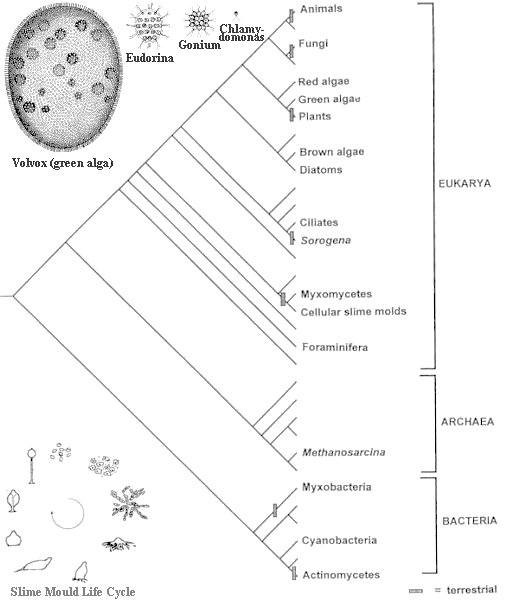
Slime moulds inhabit forest soil and consume bacteria and yeast, which they track by chemotaxis - chemical gradient sensing (of folic-acid in this case). Starvation, however, prompts the normally unicellular cells to aggregate and develop to a true multicellular organism, producing a fruiting body comprised of cellular, cellulosic stalk supporting a bolus of spores. Thus, slime mould has evolved mechanisms that direct the differentiation of a homogeneous population of cells into distinct cell types, regulate the proportions between tissues and orchestrate the construction of an effective structure of the dispersal of spores. Many of the genes necessary for these processes in slime mould were inherited by Metazoa (animal with specialized cells) and fashioned through evolution for use within many different modes of development. Analysis of the proteins shows that slime mould diverged from the animal-fungal lineage after the plant-animal split, but it seems to have retained more of the diversity of the ancestral genome than have plants, animals or fungi, i.e., it possesses a level of complexity that is greater than the yeast, but much simpler than plants or animals. It represents one of the earliest branches from the last common ancestor of all eukaryotes, it is also one of the 13 separate inventions of multicelluarity (Figure 01). Insert in the same image shows the relatives of green algae going from the single cell Chlamydomonas to the 16-cell Gonium, Eudorina, and finally to the largest Volvox, which may consist of 50000 or more cells.
|


