| Home Page | Overview | Site Map | Index | Appendix | Illustration | About | Contact | Update | FAQ |
|
|
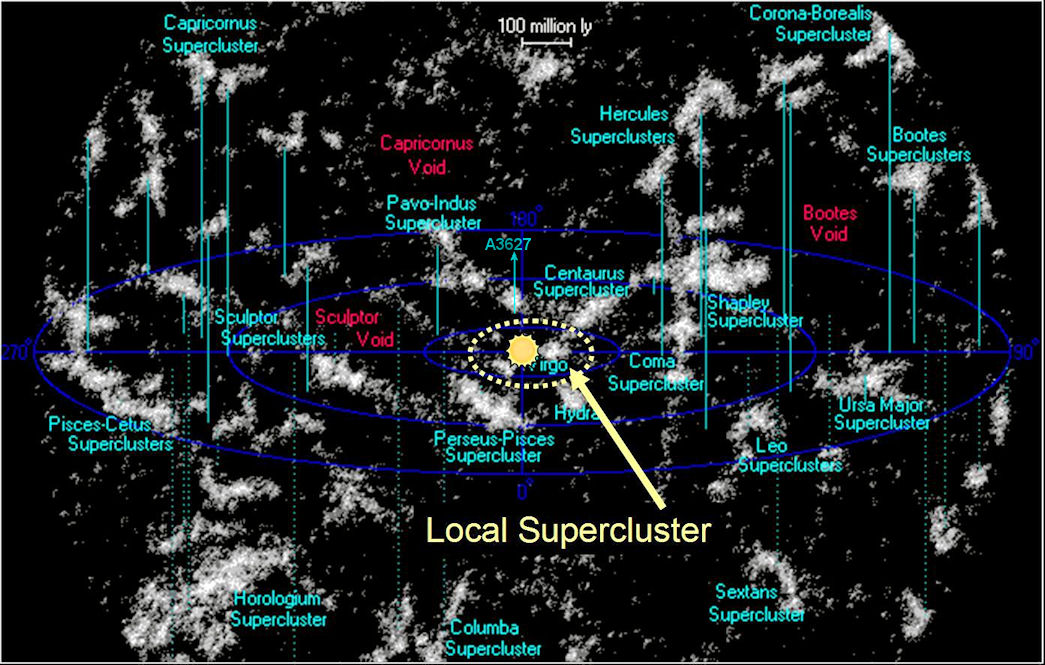
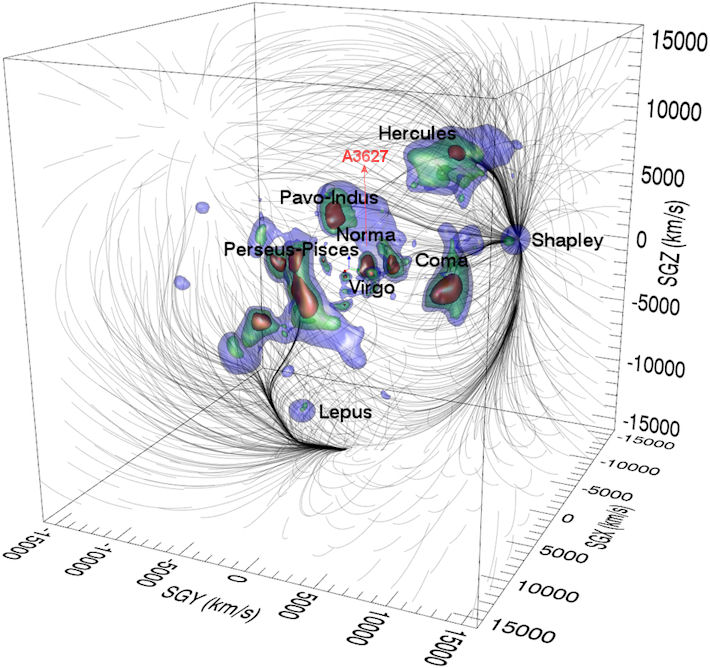
The Laniakea (Lani=Heaven + akea=immense in Hawaiian) supercluster is a more precisely defined entity than the Virgo cluster (the region enclosed inside the ellipse in Figure 03-06c). Figure 03-06d shows the 2014 update of the density map in the Virgo neighourhood (derived from the velocity measurements, red-high, green-intermediate, blue-low). The velocity flows (of the galaxies) are illustrated by the black threads, ultimately all flows appear to drain towards the Shapley supercluster. The flow pattern within Laniakea is shown in Figures 03-06e and 03-06f. |
Figure 03-06c Virgo (Local) Supercluster [view large image] |
Figure 03-06d Density Map [view large image] |
 |
 |
because it renders a neat construction of Laniakea. This value of Ho is considerably different from the value of 67.15 km/s-Mpc obtained from the latest Planck measurement and required an explanation. Anyway, for a given observed Vo ,  Vp = Ho d , which yields a relationship of 1000 km/s (in the velocity grids of Figure 03-06d,e,f) equivalence to 13.3 Mpc (the relative distance scale). Vp = Ho d , which yields a relationship of 1000 km/s (in the velocity grids of Figure 03-06d,e,f) equivalence to 13.3 Mpc (the relative distance scale). |
Figure 03-06e Galactic Flow |
Figure 03-06f Supercluster, Laniakea [view large image] |
 is computed from the divergence of the velocity field Vp related to sources and sinks :
 Vp = -Hof(
 m,
m, )m,) is a function of the cosmic mass m (dark+brayonic) and dark energy parameters respectively. A casual inspection of the density profile in Figure 03-06f shows that the sources of the velocity flows are from the lower density region with sinks in the higher density ridges. It seems that galaxies are attracted by some unseen entity - probably the dark matter - over there.