In a eukaryotic cell, the plasma membrane is a lipid bilayer that separates the materials inside the cell from the environment surrounding it.
The outer surface of the membrane contains structures that allow cells to communicate with each other.
| Home Page | Overview | Site Map | Index | Appendix | Illustration | About | Contact | Update | FAQ |
|
|
There are two types of cells: prokaryotic and eukaryotic. Prokaryotic cells have no nucleus and form unicellular organisms such as bacteria. The cells in protista, fungi, plants and animals are eukaryotic cells, which have a nucleus. In a eukaryotic cell, the plasma membrane is a lipid bilayer that separates the materials inside the cell from the environment surrounding it. The outer surface of the membrane contains structures that allow cells to communicate with each other. |
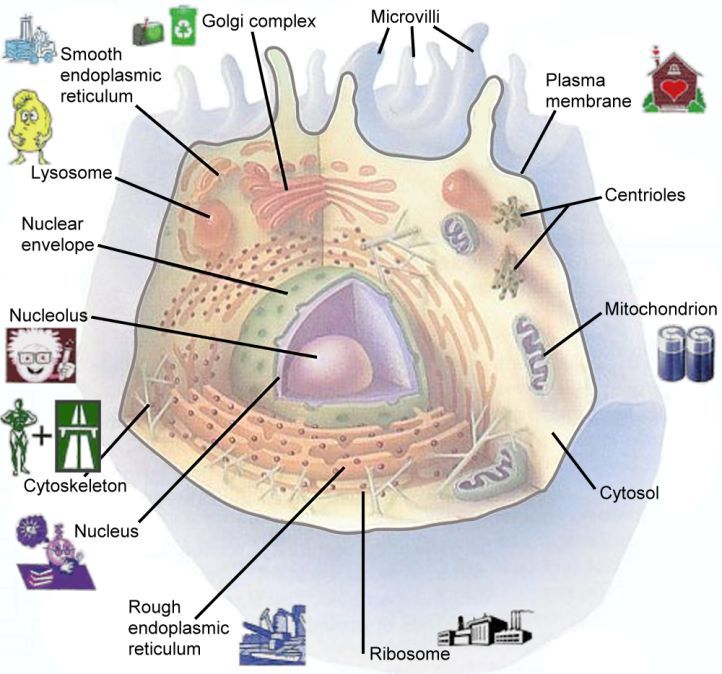
Figure 11-30a Eukaryotic Cell |
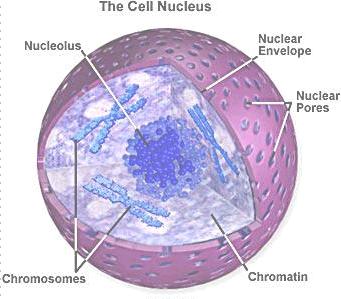
Figure 11-30b Cell Nucleus |
Within the cells are specialized structure called organelles that carry out specific functions in the cell. The cell structure is shown in Figure 11-30a, the functions of the cell are shown in Table 11-02 below.
| STRUCTURE | DESCRIPTION | FUNCTION | PKC |
|---|---|---|---|
| STRUCTURAL ELEMENTS | |||
| Cytosketeton | Network of protein filaments | Structural support; cell movement | No |
| Flagella(cilia, microvilli) | Cellular extensions | Motility or moving fluids over surfaces | Yes |
| Centrioles | Hollow microtubules | Moving chromosomes during cell division | No |
| ENDOMEMBRANE SYSTEM | |||
| Plasma membrane | Lipid bilayer in which proteins are embedded | Regulates what passes into and out of cell; cell-to-cell communication | Yes |
| Endoplasmic reticulum | Network of internal membranes; forms compartments and vesicles | Rough type processes proteins for secretion and synthesizes phospholipids; smooth type synthesize fats and steroids | No |
| Nucleus | Structure bounded by double membrane; contains chromosomes | Control center of cell; directs protein synthesis and cell reproduction | No |
| Golgi complex | Stacks of flattened vesicles | Modifies and packages proteins for export from cell; forms secretory vesicles | No |
| Lysosomes | Vesicles derived from Golgi complex that contain hydrolytic digestive enzymes | Digest worn-out mitochondria and cell debris; play role in cell death | No |
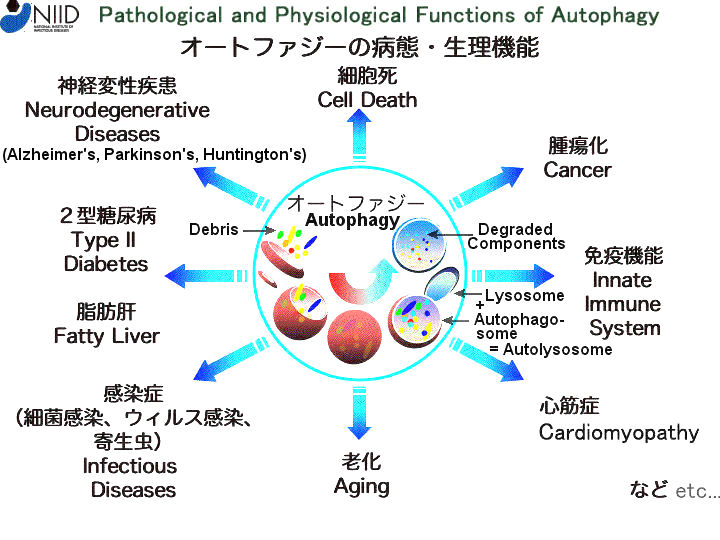
| Autophagy | Vesicles to collect debris within the cell | Malfunction causes accumulation of cell damage leading to diseases and aging (see Malfunction of Autophagy) | No |
| ENERGY-PRODUCTING ORGANELLES | |||
| Mitochondria | Bacteria-like elements with inner membrane | Battery of the cell by ATP synthesis; site of oxidative metabolism | No |
| ORGANELLES OF GENE EXPRESSION | |||
| Chromosomes (during cell division) / Chromatins | Long threads of DNA that form a complex with protein | Contain hereditary information | Yes |
| Nucleolus | Site of rRNA synthesis | Assembles ribosomes | No |
| Ribosomes | Small, complex assemblies of protein, often bound to ER | Site of protein synthesis | Yes |
 |
ultimately determines the cell's characteristics. Within the nucleus, there are masses of threads called chromatin, which is indistinct in the non-dividing cell. The long string of DNA winds around a spool made with proteins called histone, which also plays a role in gene regulation. The chromatins condense to chromosomes at the time of cell division. Figure 11-31 shows the packed chromatin unwinding to a DNA strand. It also shows the appearance of chromosome in mitosis stage. The nucleolus is the specialized part of chromatin in which the ribosomal RNA (rRNA), is produced (Figure 11-30b). The telomeres lie at the tips of the chromosome. They have hundreds to thousands of repeats of a specific 6-nucleotide DNA sequence. The telomeres lose 50 to 200 of these nucleotides at each mitosis; gradually shortening the chromosome. After about 50 divisions, a critical amount of telomere DNA is lost, which somehow signals the cell to stop mitosis. The cell may remain alive for a while but is unable to divide further. This is the cellular clock, which pre-determines the life span of the cell. |
Figure 11-31 Chromosome |
See "DNA orgainization". |