| Home Page | Overview | Site Map | Index | Appendix | Illustration | About | Contact | Update | FAQ |
![]() |
|
Figure 07a Triassic Period |
and ran on their hind legs, captured prey with fore- limbs and jaws, and balanced their swaying bodies with stiffly extended tails. |
![]() |
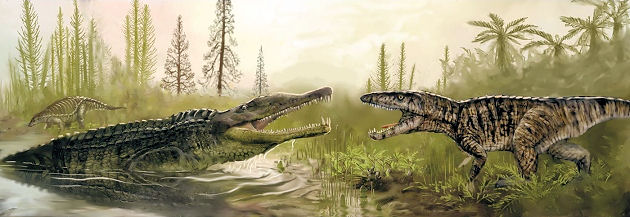
primitive reptile) on the left. Figure 07b shows a confrontation between the phytosaur and a top predator. The plateosaurus is a primitive member of a group called sauropods (lizard-footed), which walked on four feet, developed massive legs both fore and aft, and had teeth that were suited only to a diet of soft, juicy plants. Plateosaurus has peg-like teeth and the hands had huge thumb claws, used perhaps to gather in plant material |
Figure 07b Triassic Confrontation |
from tall trees. The other subdivision is called theropods (beast-footed). With a few exceptions, the theropods were bipeds that walked on three birdlike toes, had short forelegs, and were carnivorous. |
![]() |
shown in Figure 07c. The difference in the orientation of the pubis is related to the feeding habits and stance when walking. All ornithschians were herbivores and many were bipedal. As vegetarians they would have a large gut to allow the food to pass through sufficiently slowly to allow it to be digested, a process involving symbiotic bacteria. Thus, an erect ornithischian would have a "beer Belly", which has to hang between the legs with the pubis pointing backward. The bipedal saurischians were all carnivores so their guts would have been much smaller as meat is quickly digested. |
Figure 07c Pelvic Structures |
![]() |
|
Figure 07d Sauropodomorpha |
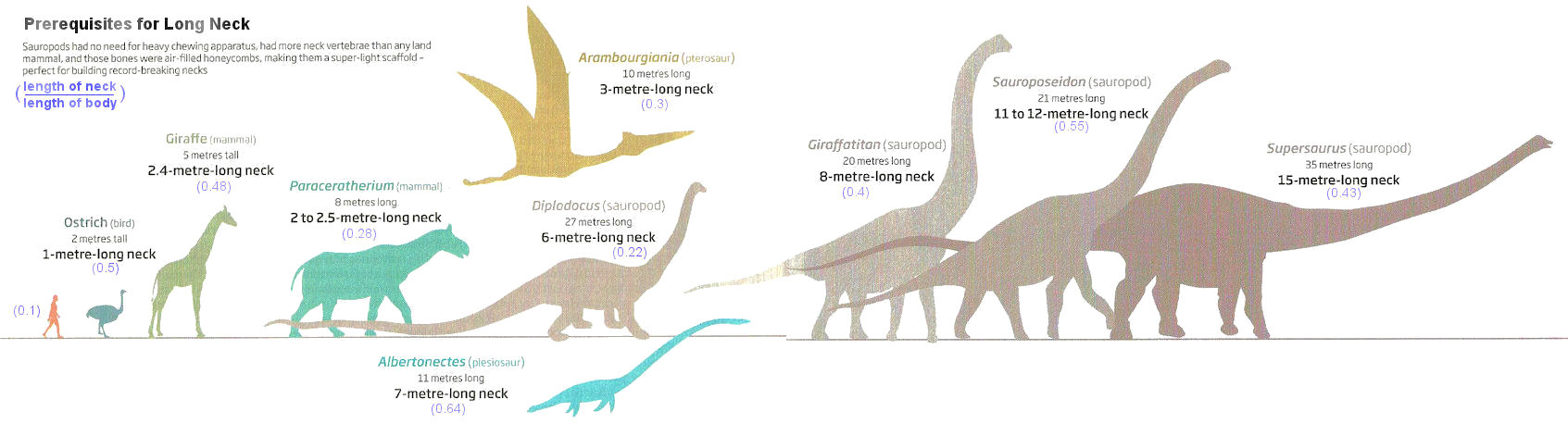
The long neck is an adoaptation to the foliage over head. The structure satisfies certain requirements as shown in Figure 07e. The only animal that possesses higher neck to body ratio is the Albertonectes with the help of buoyancy in water. |
![]() |
|
Figure 07e Prerequisites for Long Neck [view large image] |
| Function | Requirement | Adoptions | Disadvantage |
|---|---|---|---|
| Protection and Competition | Large size | Eat more, breed slow | First to die when food is scarce |
| Reproduction | Enough # of young | Laid eggs in clutches more often | Provide no care for offsprings |
| Growth | High growth rate (2 tonnes/year) |
Fast metabolism | Need lots of food (1 tonnes/day) |
| Support and movement | A body plan to move massive body | Long neck, small head, barrel-like body, thick sturdy legs, and walked on all four. | Movement becomes cumbersome |
| Breathing | Lots of oxygen | Bird-like lungs, and air sacs inside the body | No disadvantage; but also help to reduce weight and stop overheating |
| Digestion | Eating huge amount of poor nutritional vegetation | Long neck and peg-like teeth to pluck leaves and branches; long retention time in the digestive tract | Lengthy microbial fermentation inside producing lot of gas |
![]() |
![]() |
The classic scenarios of mammalian evolution posits an orderly acquisition of key evolutionary innovations leading to adaptive diversification (first column in Figure 07f). But newly discovered fossils in the 2000's show that evolution of such key characters as the middle ear and the tribosphenic teeth (cutting and grinding molars) is far more labile among Mesozoic (250 - 65 MYA) mammals (Figure 07g). Many of such mammal groups led to dead- |
Figure 07f Diversification |
Figure 07g Middle Ear and Molars [view large image] |
end lineages. But some iteratively developments eventually succeeded into modern mammals (Figure 07f). |
![]() |
![]() |
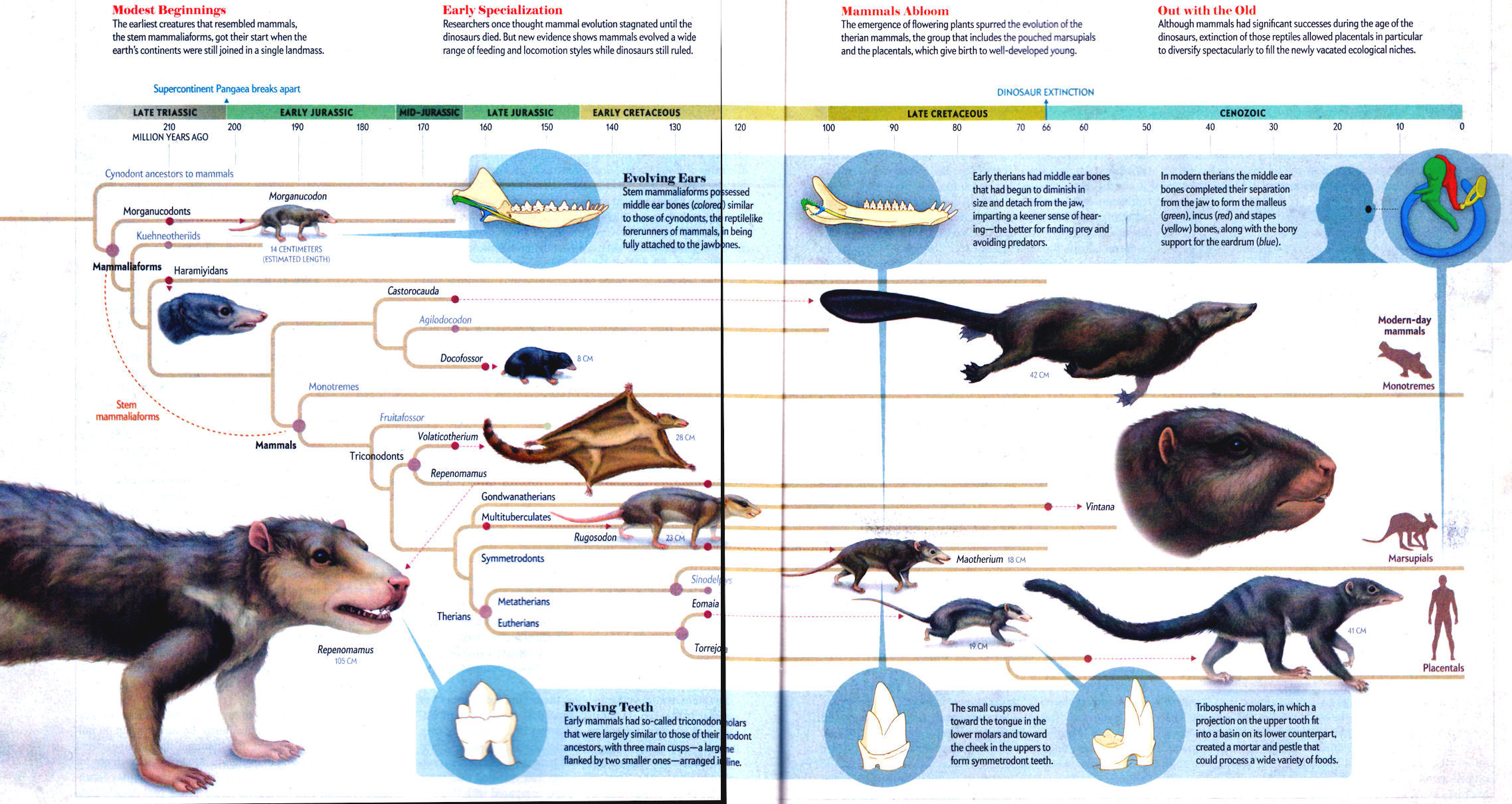
As more mammalian fossils have been unearthed in the past few years, a very different picture of early mammals has emerged to replace the shrew-like description. Dinosaurs may have been the dominant creatures, but mammals were very much a part of their world. They invaded many more ecological niches and developed many more lifestyles than was previously thought possible before the extinction of the dinosaurs. Figure 07h presents a brief guide to early mammal evolution. According to this diagram, mammals evolved from a group of "mammals-like" reptiles called cynodonts that |
Figure 07h Early Mammal Evolution [view large image] |
Figure 07i Early Mammals [view large image] |
prospered during the Triassic period. The larger members of this group went extinct at the end of the Triassic and were displaced by dinosaurs, but some |
![]() |
![]() |
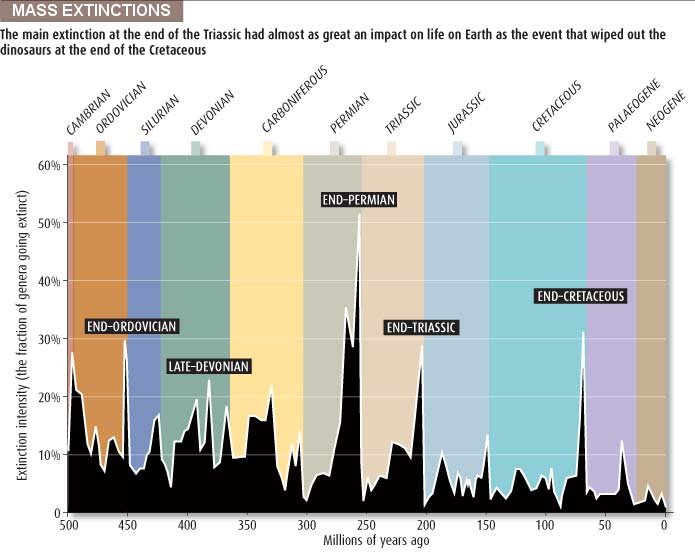
happened, it didn't affect everything. Plenty of groups, including small predatory dinosaurs, the early mammals, and some crocodile relatives survived into the Jurassic. Yet large groups of archosaurs mysteriously vanished at the end of the Triassic (Figure 07k). It really isn't obvious why the non-dinosaurs get hammered the most. Anyway, the end-Triassic extinction pruned a number of dinosaurs, but the group as a whole marched on, and prospered in the Jurassic period. |
Figure 07j Extinctions |
Figure 07k Triassic Extinction [view large image] |