Home Page Overview Site Map Index Appendix Illustration About Contact Update FAQ


Quantum Field Theory


Gyromagnetic Ratio and Anomalous Magnetic Moment (+ 2021, 2022 Updates)

The anomalous magnetic moment for the electron and muon illustrates the progress of our understanding in particle physics from classical mechanics to quantum theory, quantum field theory, the Standard Model, and beyond.

Classical g-ratio A classical electron moving around a nucleus in a circular orbit has an orbital angular momentum, L=mevr, and a magnetic dipole moment, = -evr/2, where e, me, v, and r are the electron´s charge, mass, velocity, and radius, respectively. A classical electron of homogeneous mass and charge density rotating about a symmetry axis has an angular momentum, L=(3/5)meR2, and a magnetic dipole moment, = -(3/10)eR2, where R and are the electron´s classical radius and rotating frequency, respectively. The classical gyromagnetic ratio of an orbiting or a spinning electron is defined as the ratio

Figure 07 Classical g-ratio [view large image]

of the magnetic moment to the angular momentum. In both cases one finds cl = /L= -e/(2me). The minus sign indicates that is in the opposite direction to L (see Figure 07).

In quantum theory, the interaction between an electron and a magnetic field can be portrayed by the Feynman diagram in Figure 08a, which shows a photon from the magnetic field is absorbed by the electron and thus altered its trajectory. The gyromagnetic ratio derived from the Dirac equation takes the form: e = /L= -g e/(2me), where g = 2 is related to the fact that the spin of the electron equals to /2.
Magnetic Moment Interaction Vertex Correction If the vertex correction as shown in Figure 08b is taken into account, then g = 2 ( 1 + /2), where = e2/(4c) ~ 1/137.036 is the fine structure constant giving g - 2 = 0.002322814. The extra term arises from the electron self-interaction, in which it emits and reabsorbs a virtual photon, making a loop in the Feynman diagram as shown in Figure 08b. The same process also applies to the muon.

Figure 08a Quantum Description

Figure 08b Vertex Cor-rection [view large image]

The more accurate calculation including higher loop diagrams up to the 4th order term yields the following expression:
g - 2 = 2 ( /2 - 0.328 (/2)2 + 1.181 (/2)3 - 1.510 (/2)4) = 0.0023193042800. The experimental value is: g - 2 = 0.0023193043768 (in agreement with the calculated value to ten significant figures).

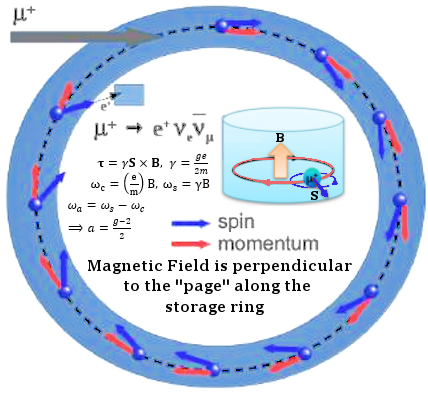
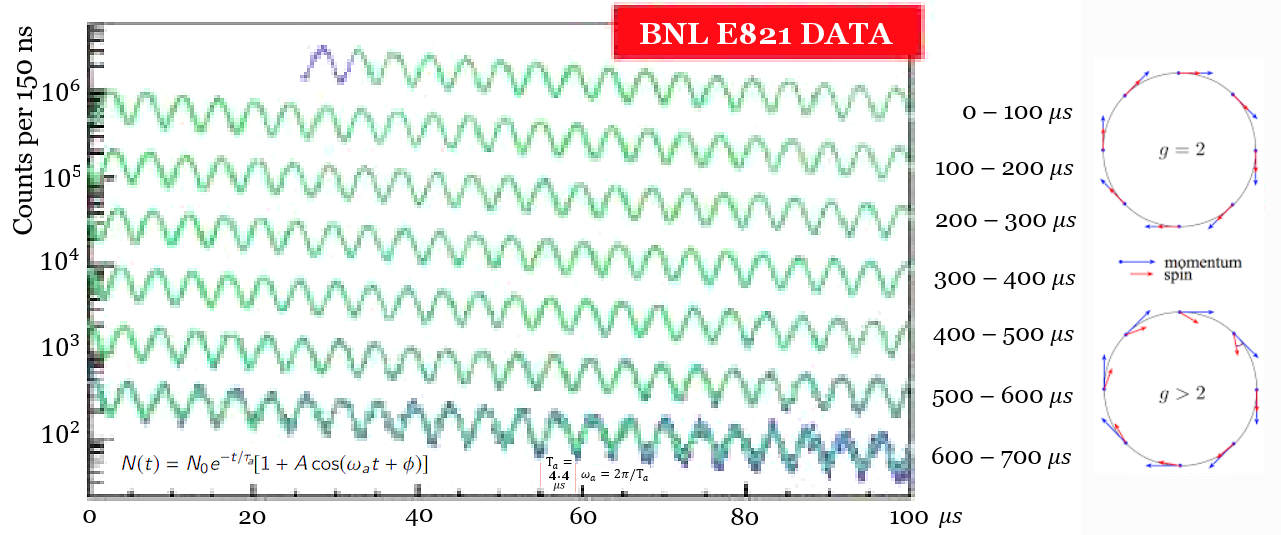
In calculating the effects of the cloud of virtual particles, we need to include not just the effects of virtual photons and virtual electron-positron pairs, but also virtual quarks, virtual Higgs particles, and, in fact, all the particles of the Standard Model. It turns out, though, that because of the larger muon mass, any such heavy particles would affects the muon magnetic moment more than the electron magnetic moment. The muon g - 2 has been calculated with the Standard Model to a precision of 0.6 ppm (parts per million). The calculated value with the combined effect is g - 2 = 0.0023318360. A remarkable fact is that the muon g - 2 factor not only can be predicted to high precision, but also measured to equally high precision. The measurements at Brookhaven National Laboratory in 2001/2004 (Figure 09) yields an average value of g - 2 = 0.0023318416. Thus, the comparison of measurement and theory provides a sensitive test of the Standard Model. If there is physics not included in the current theory, and such new physics is of a nature that will
g-2 Experiment affect the muon's spin, then the measurement would differ from the theory. This is what appears to have been observed, although there are several interpretations of the result that must be considered. One of the missing pieces in the theoretical calculation is the exotic particles predicted by the theory of supersymmetry. Although these particles are rare and unstable their mere existence in the vacuum would modify observable quantities such as the muon magnetic moment.

Figure 09 g-2 Experiment [view large image]

The modern version prefers to use a = (g - 2)/2 with the subscript to denote muon,
a(BNL) = 11659208x10-11 (from BNL Muon Experiment),
a(SM) = 11659180x10-11 (from SM theoretical calculation); a(BNL) - a(SM) = 28x10-11.
[2021 Update]

[End of 2021 Update]

[2022 Update]

The g factor of a bound-electron is modified by the properties of the nucleus such as the nuclear mass, polarizability and the charge radius. However, by studying the differences of the g-factor (g) between isotopes, many common QED contributions cancel out owing to the identical electron configuration, making it possible to resolve the intricate effects stemming from the nuclear differences.
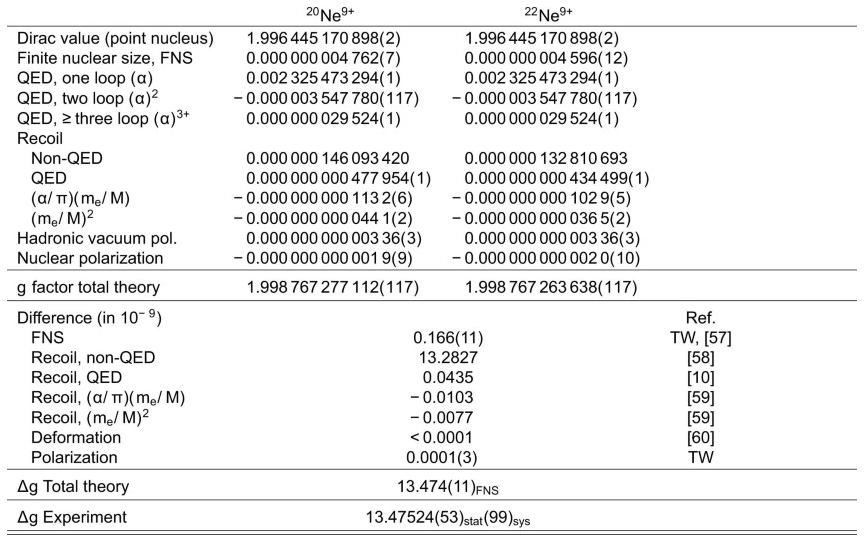
Dg Bound-state Dg Experiment As shown by the table in Figure 19, the values of g for 20Ne9+ and 22Ne9+ have been calculated individually, from which the difference g = 13.474x10⁻⁹ is obtained. The experimental value by measuring the g difference of 2 isotopes directly obtains g = 13.47524x10⁻⁹ - an improvement of accuracy about 2 orders of magnitude limited in precision solely by the uncertainty of the

Figure 19 g2 Bound-state [view large image]

Figure 20 g Experiment
[view large image]

charge-radius difference (finite nuclear size, FNS) of the isotopes
d< r2 >1/2 = 0.0530(34)fm.

See original article : "Measurement of the bound-electron g-factor difference in coupled ions".

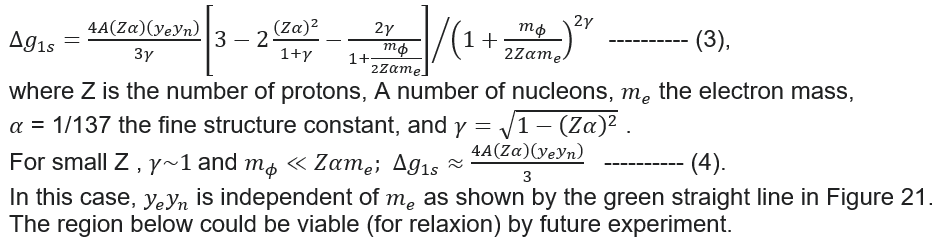
The g can be applied to set constraint on the parameters for the new-physics (NP) search via the hypothetical relaxion (see "Relaxion Review"). The scheme is similar to the introduction of the as yet discovered axion by adding a boson to the Lagrangian density (to resolve the problem). In this case, it is the "Hierarchy Problem with Higgs". It is suggested that the relaxion couples to the Higgs boson to endow it with heavy mass, and as the early Universe expanded, the expansion would have weakened this coupling, thereby 'relaxing' the Higgs mass down to its currently observed value. Anyway, g is related to the coupling constant yeyn and the mass of the relaxion m by the following formula for the bound electron in 1s state (see more details in "Fifth-force search with the bound-electron g factor") :
Relaxion Detection

Figure 21 Relaxion Constraint [view large image]

DIY Relaxion Coupling For example, g = 13.475x10⁻⁹ for Ne9+ isotopes as shown by the table in Figure 19; the rest of the parameters are : A = 20, Z = 10, = 1/137, me = 510 kev; thus, Z = 0.073 << 1, and ~ 1. Figure 22 is a DIY plot with the relaxion coupling yeyn (in log scale) against m (in unit of kev) according to the formula shown below.
Since the most advanced Large Hadron collider (LHC) failed to detect any sign of relaxion up to energy of 7 Tev and according to various predictions on its coupling strength (Figure 21), the theoretical curve in Figure 22 indicates that the coupling/mass combo of relaxion would be weaker (under the curve, should it be a real thing).

Figure 22 DIY Relexion

In comparison, the electromagnetic coupling = 1/137 = 7.3x10⁻³, while me ~ 5x10² kev.

See "Particle physics isn’t going to die — even if the LHC finds no new particles" on the disperate search for New Physics (NP).

[End of 2022 Update]

Go to Next Section
 or to Top of Page to Select
 or to Main Menu

.