
| Home Page | Overview | Site Map | Index | Appendix | Illustration | About | Contact | Update | FAQ |
 0, see Eq.(32) for the case with n = 0):
 (y +
(y +  y)n - yn yn (1 + y/y)n - yn
  yn (1 + ny/y) - yn nyn-1y = nyn-1dy ---------- (26)
  . In Eq.(10), we can re-arrange the y variable to one side and re-write y-2dy = -d(y-1) by applying the formula in Eq.(26) for the case of n = -1. Integration to obtain the solution becomes trivial once it is written in this form. Derviation of the differentiation for the sine and cosine functions:x) - sinx = sinx cosx + cosx sinx - sinx
  cosx x = cosx dx ---------- (27)x) - cosx = cosx cosx - sinx sinx - cosx -sinx x = -sinx dx ---------- (28) ---------- (29a) ----------(29b)
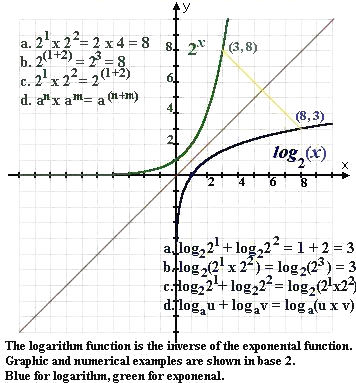 |
Let us start from the differentiation of the logarithmic function loga(y) with an arbitrary base a: d[loga(y)] loga(y + y) - loga(y) loga(1 + y/y) ( y/y) loga(1 + y/y)(y/y) ---------- (30)where we have applied the logarithmic relations (Figure 11): loga(u/v) = loga(u) - loga(v) ---------- (31a) loga(u)n = n loga(u) ---------- (31b). |
Figure 11 Logarithm |
y, e (1 + 1/n)n, a = e, ln(y) = loge(y), and use the identity loga(a) = 1; then y/y = dy/y -------- (32).
 |
 |
y = ei x = cos x + i sin x ---------- (34) This relationship was discovered by the Swiss mathematician Leonhard Euler (1707-83). The modern derivation can be obtained easily if we perform a Taylor series expansion about the point xo = 0 for ex, substituting to the independent variable with ix and comparing the result with Eqs.(29a,b). The Euler's divine formula (Figure 13) : ei  + 1 = 0 ---------- (35) + 1 = 0 ---------- (35)
|
Figure 12 Log-a-Rhythm [view large image] |
Figure 13 Euler's Formula [view large image] |
is a straight forward application of Eq.(34). It contains all the special symbols in mathematics: e, i =  , , 1, and 0. , , 1, and 0. |

