
| Home Page | Overview | Site Map | Index | Appendix | Illustration | About | Contact | Update | FAQ |
|
|
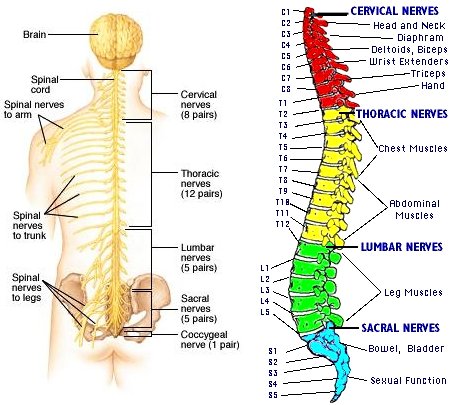
The peripheral nervous system is outside the CNS. It consists of the various nerves that connect particular parts of the CNS with particular organs. Humans have 12 pairs of cranial nerves and 31 pairs of spinal nerves. Cranial nerves (Figure 05) are either sensory nerves, motor nerves, or mixed nerves. All of them, except the vagus nerve, control the head, the face, the neck, and the shoulders. The vagus nerve controls the internal organs. Table 04 lists the functions of the various cranial nerves. All spinal nerves (Figure 06) are mixed nerves that take impulses to and from the spinal cord. Table 05 |
Figure 05 Cranial Nerves [view large image] |
Figure 06 Spinal Nerves |
describes the symptom of spinal cord injury (SCI) with the particular spinal nerve(s). |
| Cranial Nerve | CN# | Brain Region | Major Functions |
|---|---|---|---|
| Terminal§ | 0 | Near the olfactory | Reception of pheromone for sex |
| Olfactory | 1 | Cerebral Cortex | Smell |
| Optic | 2 | Limbic System | Vision |
| Oculomotor | 3 | Midbrain | Eyelid & eyeball movement; pupil dilation |
| Trochlear | 4 | Pons | Control downward & lateral eye movement |
| Trigeminal | 5 | " | Chewing; sensation of face & mouth |
| Abducens | 6 | " | Control lateral eye movement |
| Facial | 7 | " | Control most facial expressions; secretion of tears & saliva; taste; ear sensation |
| Auditory | 8 | Medulla | Hearing; balance |
| Glossopharyngeal | 9 | " | Taste; swallowing; sensation from tongue, tonsil, pharynx, carotid blood pressure |
| Vagus | 10 | " | Sensory, motor and autonomic functions of viscera - glands, digestion, heart rate, breathing rate, aortic blood pressure |
| Spinal Accessory | 11 | " | Controls muscles used in head movement |
| Hypoglossal | 12 | " | Controls tongue movements |
| Spinal Nerve(s) | Innervated Body Part(s) | Symptom(s) of SCI |
|---|---|---|
| C1 | Head and Neck | Quadriplegia |
| C2-C4 | Diaphragm | Breathing problem |
| C5 | Deltoids, biceps | No control at wrist or hand |
| C6 | Wrist extenders | No hand function |
| C7-T1 | Triceps, hand | dexterity problems with hand and fingers |
| T2-T8 | Chest muscles | Paraplegia, poor trunk control |
| T9-T12 | Abdominal muscles | Paraplegia |
| Lumbar and Sacral | Leg muscles, bowel, bladder, sexual organs | Decreasing control of hip flexors and legs, dysfunction of bowel, bladder, and sex |


