 |
 |
|
Figure 05a Carboniferous Period [view large image] |
Figure 05b Reptiles |
freedom to lay their eggs on land. Their descendants include all other reptiles, dinosaurs, birds and mammals (Figure 05b). |

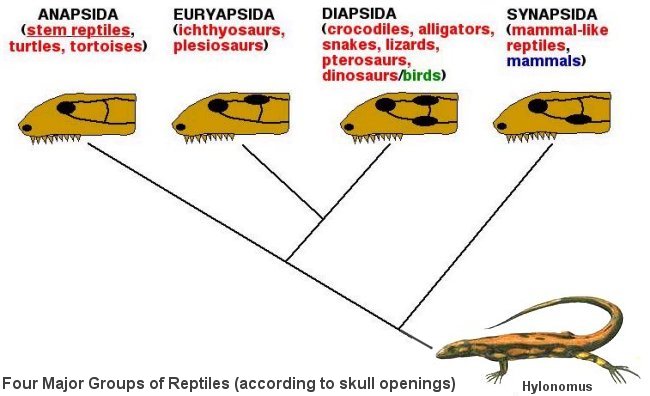 |
Hylonomus is the oldest vertebrate recognized as a reptile. Unlike most of the amphibians, these animals were generally not tied to water for reproduction, but laid eggs that were able to survive in a terrestrial environment. Hylonomus had an unbroken expanse of bone behind each eye opening. Other reptiles had one or more gaps, the temporal openings, occupying various positions and enclosed by various bones. Though these patterns vary in details, the gaps themselves - or the lack of them - are the basis for splitting the reptiles into four major groups as shown in Figure 05c. |
Figure 05c Groups of Reptiles |