
| Home Page | Overview | Site Map | Index | Appendix | Illustration | About | Contact | Update | FAQ |
|
The gymnosperms produce naked seeds; that is, the seeds are not enclosed by fruit. There are four divisions of gymnosperms (Cycadophyta, Ginkgophyta, Gnetophyta, and Coniferophyta; see Figure 19). Cycads are cone-bearing, palmlike plants found today mainly in tropical and subtropical regions. Only one species of ginkgo, the maidenhair tree, survives today. The gnetophyta has only three genera left. The largest group of gymnosperms is the cone-bearing conifers, which include pine, cedar, spruce, fir, and redwood trees. These trees have needlelike leaves that are well adapted to not only hot summers but also cold winters and high winds. Most gymnosperms are evergreen trees. |
Figure 19 Gymnosperms |
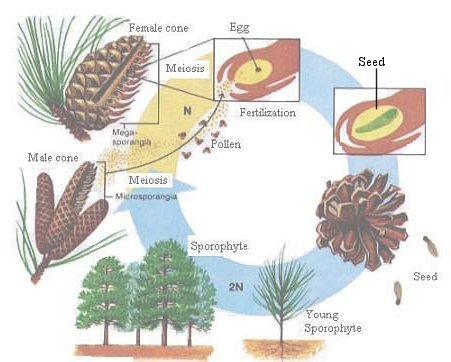 |
opening. During pollination, pollen grains are transferred from the male cone to the female cone. Once enclosed within the female cone, the pollen grain develops a pollen tube that slowly grows toward the ovule. The pollen tube discharges two nonflagellated sperms. Only one of the sperms fertilizes an egg in the ovule 15 months after pollination. After fertilization, the ovule matures and becomes the seed composed of the embryo, its stored food, and a seed coat. Finally, in the third season, the female cone, by now woody and hard, opens to release its seeds, whose wings are formed from a thin, membranous layer of the cone scale. When a seed germinates, the sporophyte embryo develops into a new pine tree, and the cycle is complete (Figure 20). |
Figure 20 Conifer Life Cycle |
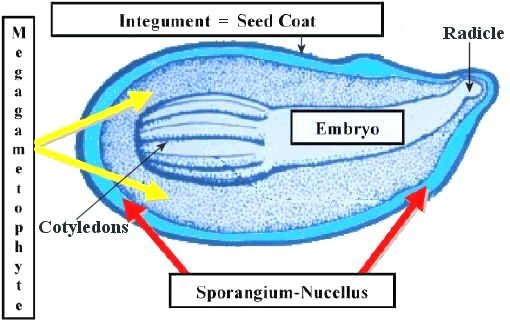 |
including small mammals, birds, and insects. The embryo is found in the corrosion cavity, a pit in the centre of the megagametophyte that is fully filled by the embryo in mature seeds. It consists of the cotyledons (first leaf), shoot apical meristem, root apical meristem, root cap and suspensor. The cotyledons and shoot apical meristem point towards the wider end of the seed; while the radicale (embryonic root) and suspensor are at the more pointed end. The suspensor is found at the base of the root cap and plays a role early in embryo development by pushing the embryo into the megagametophyte. |
Figure 21 Seed Anatomy |


