| Home Page | Overview | Site Map | Index | Appendix | Illustration | About | Contact | Update | FAQ |
|
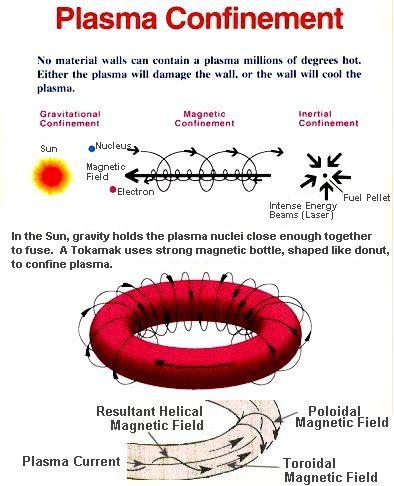
The confinement of a plasma by self-magnetic fields is very important in thermonuclear reactor and other applications. However, long-lived pinched plasmas are extremely difficult to maintain. The plasma column is observed to break up rapidly. The reason for the disintegration of the column is the growth of instabilities. The column is unstable against various departures from cylindrical geometry. Small distortions are amplified rapidly and destroy the column in a very short time. The mechanisms of instability in plasma physics are nearly unlimited. Some instabilities are comparable to examples borrowed from fluid mechanics, as the Rayleigh Taylor's instability, which consists of superposing two fluids with the heaviest on top. Imagine for example a vessel in which you pour water and then carefully add oil over the top. The system is then in a state of meta-stable equilibrium. The slightest nudge will provoke a change with the heavier fluid dropping to the bottom, which corresponds to a stable equilibrium. Another type of instability are kink instabilities, which occur when a current parallel to the magnetic field cause twisting of the field lines, recalling the effect obtained if we twist a rope too much: the rope twists out and kinks. The sausage or neck instability causes a greater inwards pressure at the neck of a constriction. This serves to enhance the existing distortion. |
Figure 26 Confinement of Plasma [view large image] |
The following provides a little bit more detail on the basic mechanism from a simplified configuration, to the pinch effect and finally the instabilities. |
 = B(r). In steady-state dv/dt = 0, and negligible gravitational interaction, the equation of motion in Magnetohydrodynamics (MHD) is simplified to (Figure 27,a):
 |
 |
Figure 27 Plasma Confinement, Diagram [view large image] |
See Ampere's Law in both forms. |

 )1/2, where is the initial mass density.
 |
For small scale lab experiment involving R0 ~ 10 cm, E ~ 103 volts/cm, ~ 10-8 gm/cm3 of deuterons, v0 ~ 107 cm/sec; while the current I ~ c2R0E/v0 would be in the order 105 amp. Eventually in a time interval of less than  = R0/v0 ~ 10-6 sec the inward flow bounces back and the cycles repeat as shown in Figure 28,b. It is conjectured that the movement will approach to a steady state at some radius less than R0 . = R0/v0 ~ 10-6 sec the inward flow bounces back and the cycles repeat as shown in Figure 28,b. It is conjectured that the movement will approach to a steady state at some radius less than R0 . |
Figure 28 Pinch Effect [view large image] |
The pinching action would be very desirable as the effect pulls the plasma column away from the wall and thus prevents burning it up. |
. The plasma column is observed to break up rapidly. There are many types of instabilities. In the kink instability, the B magnetic lines are bunched together above, and parted
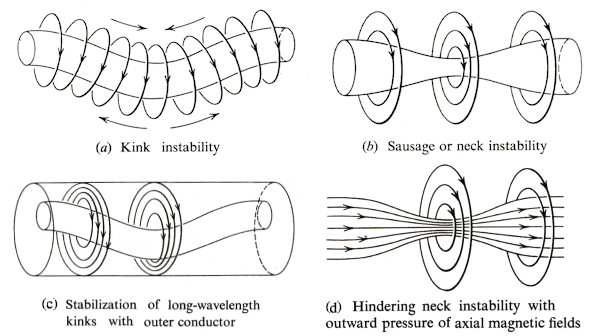 |
below causing the column to bend downwards as shown in Figure 29,a. The sausage or neck instability develops more compression at one point in the column causing an increased pressure inside to oppose the magnetic pressure (Figure 29,b). Instability is the result of distortion of the trapped axial field lines Bz. Thus, the disturbance can be stabilized by bumping up the axial field such that (Bz)2 > (B)2/2 (Figure 29,d). Another stabilizing technique for long-wavelength kink is provided by the container wall to straighten up the distorted field lines (Figure 29,c).
|
Figure 29 Instabilities |
See "Plasma Stability" for further detail. |