| Home Page | Overview | Site Map | Index | Appendix | Illustration | About | Contact | Update | FAQ |
Unstable nuclei, called radioactive isotopes, will undergo nuclear decay to make it more stable. There are only certain types of nuclear decay which means that most isotopes can't jump directly from being unstable to being stable. It often takes several decays to eventually become a stable nucleus. When unstable nuclei decay, the reactions generally involve the emission of a particle and or energy. Half-lives are characteristic properties of the various unstable atomic nuclei and the particular way in which they decay. Alpha and beta decay are generally slower processes than gamma decay. Half-lives for beta decay range upward from 10-2 sec and, for alpha decay, upward from about 10-6 sec. Bismuth-209 has the longest half-life of 2x10¹⁹ years. Half-lives for gamma decay may be too short to measure (~ 10-14 second), though a wide range of half-lives for gamma emission has been reported.
![]() |
|
Figure 14-06 Alpha Decay |
![]() |
p + e + electron-anti-neutrino with a lifetime about 15 minutes in a process known as beta decay. Neutrons in a nucleus are subject to the protection of the nuclear and the electromagnetic forces from the other nucleons, and they will remain stable provided there are not too many of them. If there are too many, such protection would not be sufficient for all of them to remain stable, and the nucleus would undergo beta decay. Figure 14-07 shows the beta decay process, in which the down quark turns into an up quark (thus changes the neutron to proton) by emitting a W- meson, which decays into an electron and an electron-anti-neutrino. |
Figure 14-07 Beta Decay |
![]() |
|
Figure 14-08a Gamma Decay |
![]() |
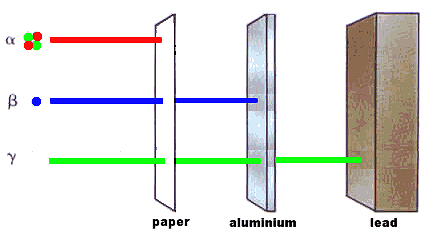
Although the three types of radiation mentioned above have roughly the same energy of a few Mev, their penetrating power is different as shown in Figure 14-08b (in Buck Rogers shooting style). The difference is due mainly to the mass and charge carried by the radiation. While the alpha ray readily ionizes the few atoms/molecules near the surface of the material, the beta ray with less mass and charge can penetrate deeper. The gamma ray carries no mass and no charge, it depends on direct hit to ionize the atoms/molecules and thus has the most penetrating power. |
Figure 14-08b Radiation Penetrating Power [view large image] |
![]() |
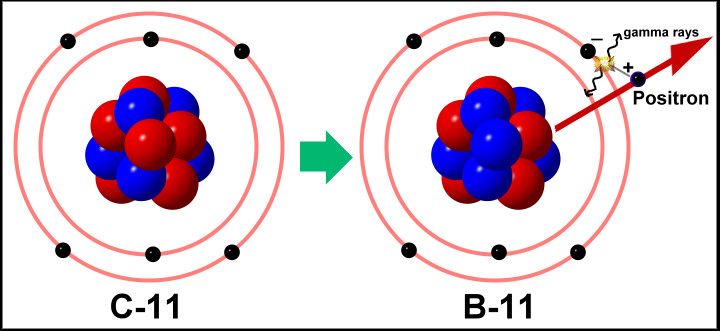
positron meets an ordinary electron the two particles annihilate and the energy contained in their mass appears as two gamma-rays of 0.5 MeV each, flying off in opposite directions. Positron radioactivity is therefore always accompanied by the emission of gamma rays with an energy of about 0.5 MeV in addition to any other gamma-rays which might be emitted. Example isotopes, which emit positrons are C-11, N-13, O-15 and F-18. These isotopes are used in positron emission tomography (PET). Figure 14-09 shows the transmutation of C-11 into B-11 by positron emission. |
Figure 14-09 Positron Emission |
![]() |
and a neutrino. Since the proton is essentially changed to a neutron, the number of neutrons increases by 1, the number of protons decreases by 1, and the atomic mass remains unchanged. By changing the number of protons, electron capture transforms the nucleus into a new element. Electron capture is also called K-capture since the captured electron usually comes from the atom's K-shell. Figure 14-10 shows another way of transmuting C-11 into B-11 by electron capture. |
Figure 14-10 Electron Capture |
| Type | Emission | Penetrating Power | Example |
|---|---|---|---|
| Alpha Decay | Helium nuclei | 1, stopped by skin, very damaging due to ionization | 92U238 90Th234 + 2He4Applicable to nuclei with Z>82, see Figure 14-02 |
| Beta Decay | Electron, high speed | 100, penetrates human tissue to ~ 1 cm | 53I131 54Xe131 + -1e0Applicable to nuclei with high neutron-proton ratio |
| Gamma Decay | Photons, high energy | 10000, highly penetrating but not very ionizing | 92U238 90Th234 + 2He4 + 2 photon Energy lost from settling within the nucleus after transmutation |
| Positron Emission | Positron | 100 | 6C11 5B11 + 1e0 Applicable to nuclei with a low neutron-proton ratio |
| Electron Capture | Neutrino (from inner shell -1e0) | ~ Infinite for Neutrino | 37Rb81 + -1e0 36Kr81 + neutrino ( e) Applicable to nuclei with a low neutron-proton ratio |