| Home Page | Overview | Site Map | Index | Appendix | Illustration | About | Contact | Update | FAQ |
|
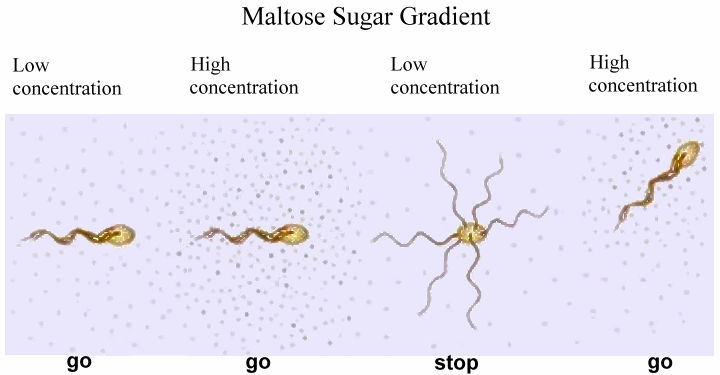
Some of the most basic features of brains can be found in bacteria because even the simplest motile organisms must solve the problem of locating resources and avoiding toxins. They sense their environment through a large number of receptors, which are protein molecules embedded in the cell wall. The action taken in response to the inputs usually depends on the gradient of the chemicals (see Figure 03a). Thus memory is required to compare the inputs from different locations. The strength of the signal is modulated by immediate past experience. This in turn regulates the strength of the signal sent by chemical messengers from the receptor to the flagellar motors. Thus even at the unicellular level, the bacteria have already possessed the ability to integrate numerous analog inputs and generate a binary (digital) output of stop or go. |
Figure 03a E. coli's Response to Chemical Gradient [view large image] |
 |
must invest a great deal of effort in raising their infants. Young reptiles function as miniature versions of adults, but baby mammals and birds are dependent because of their poor capacity to thermo-regulate, the consequence of their need to devote most their energy to growth. Most mammals solve the problem with maternal care (Figure 03b), shelter, warmth, and milk. In most birds, both parents cooperate to provide food and shelter to their young. The expanded forebrain and parental care provide mechanisms for the extra-genetic transmission of information from one generation to the next. This transmission results from the close contact with parents during infancy, which provides the young with opportunity to observe and learn from their behavior; the expanded forebrain provides an enhanced capacity to store these memories. The expanded forebrain and the observation of parents are probably necessary for the establishment of |
Figure 03b Maternal Care |
successful care giving behavior itself, as the young mature into adults that will in their turn have to serve dependent young. During the period of infant dependency, baby mammals and birds play, behavior that may be essential for the development of the forebrain. The baby's playful |
 |
 |
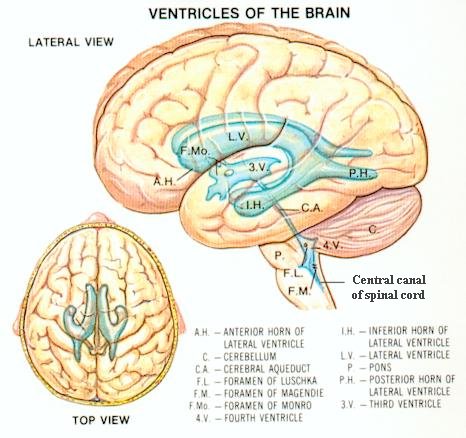
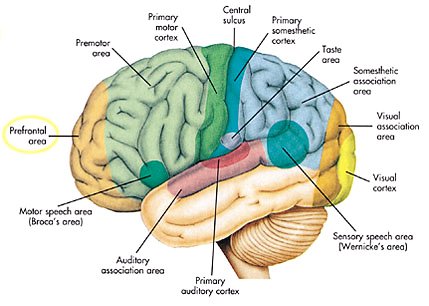
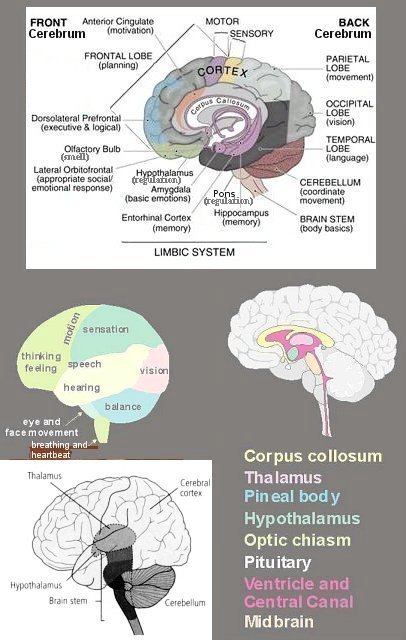
The human brain can be divided into three parts: the hindbrain, which has been inherited from the reptiles; the limbic system, which was first emerged in mammals; and the forebrain, which has its full development in human. Different views of the human brain are shown in Figure 03c, d, and e. Tables 01 lists the functions of the different parts of the human brain. The brain is separated into two hemispheres. Apart from a single little organ -- the pineal gland in the centre base of the brain -- every brain module is duplicated in each hemisphere. The left brain is calculating, communicative and capable of conceiving and executing complicated plans -- the reductionistic brain; while the right one is considered as gentle, emotional and more at one with the natural world -- the holistic brain. The cerebral cortex is covered in a thin skin of deeply wrinkled grey tissue called the grey matter (densely packed |
Figure 03c |
Figure 03d Human Brain 2 |
 |
neurons for information processing). Each infold on the surface is known as a sulcus, and each bulge is know as a gyrus. While the white tissue inside are axons -- tentacles which reach out to other cells (to relay information). The cortex can be broken down into many functional regions, each containing thousands of cortical columns (oriented perpendicular to the cortical surface). Columns are typically about half a millimeter in diameter and contain about one hundred thousand neurons. They are the units of cognition (the mental process of acquiring knowledge by the use of reasoning, intuition or perception). |
Figure 03e Human Brain 3 |
Table 02 below lists the location and functions of the major components in the human brain. |
| Structure | Location | Functions |
|---|---|---|
| Hindbrain (Reptilian Brain) |
||
| Medulla | at the top of the spinal cord | controls breathing, heart rate, and blood pressure. |
| Pons | above the medulla | regulates sensory information and facial expressions. |
| Cerebellum | at the lower rear | controls movement, coordination, balance, muscle tone, and learning motor skills. |
| Reticular Formation | a network of nerves extends from the medulla to the cerebrum | monitors the general level of activity in the hindbrain and maintains a state of arousal; essential for the regulation of sleep and wakefulness. |
| Midbrain (superior & inferior colliculus) | above the pons between the hindbrain and forebrain | relays sensory information from the spinal cord to the forebrain. |
| Pineal Gland | on top of the midbrain behind the thalamus (the third eye¤ for fishes, amphibians, reptiles, and some birds) | involves in circadian and circannual rhythms; possibly involves in maturation of sex organs. |
| Limbic System (Mammalian Brain) |
||
| Thalamus | in the middle of the limbic system | relays incoming information (except smell) to the appropriate part of the brain for further processing. |
| Hypothalamus, Pituitary Gland | beneath thalamus | regulates basic biological drives, hormonal levels, sexual behavior, and controls autonomic functions such as hunger, thirst, and body temperature. |
| Optic Chiasm | in front of the pituitary gland | left-right optic nerves cross-over point. |
| Septum | adjacent to hypothalamus | stimulates sexual pleasure |
| Hippocampus | within the temporal lobe | mediates learning and memory formation. |
| Amygdala | in front of the hippocampus | responsible for anxiety, emotion, and fear |
| Mammillary Body, Fornix | linked to the hippocampus | have a role in emotional behavior, learning, and motivation. |
| Basal Ganglia (Striatum): Caudate Nucleus, Putamen, Globus Pallidus | outside the thalamus | involves in movement, emotions, planning and in integrating sensory information |
| Ventricles and Central Canal | from tiny central canal within the spinal cord to the enlarged hollows within the skull called ventricles | fills with cerebrospinal fluid for mechanical protection. |
| Cingulate Gyrus | above corpus callosum | concentrates attention on adverse internal stimuli such as pain, contains the feeling of self. |
| Corpus Callosum | under the cingulate gyrus | is a bundle of nerve fibers linking the cerebral hemispheres, involve in language learning. |
| Forebrain (Human Brain) |
||
| Frontal Lobe (Conscious Brain) |
in front of the head | controls voluntary movement, thinking, and feeling. |
| Prefrontal Cortex | in front of the frontal lobe | inhibits inappropriate actions, forms plans and concepts, helps focus attention, and bestows meaning to perceptions. |
| Parietal Lobe | in top rear of the head | contains the primary somatosensory area that manages skin sensation. |
| Occipital Lobe | in the back of the head | contains the visual cortex to manage vision. |
| Temporal Lobe | on each side of the head above the temples | contains the auditory cortex to manage hearing and speech. |
| Stage | Age | Event(s) | DO | DON'T |
|---|---|---|---|---|
| 1 | 0 - 10 months Gestation |
* Growing neurons and connections * Making sure each section of the brain grows properly and in the right place |
Mother should: * be stress-free, eats well * take folic acid and vitamin B12 * stimulate the young brain with sounds and sensations |
* Mother should stay away from cigarettes, alcohol and other toxins |
| 2 | Birth - 6 Childhood |
* A sense of self develops as the parietal and frontal lobe circuits become more integrated. * Development of voluntary movement, reasoning, and perception * Frontal lobes become active leading to the development of emotions, attachments, planning, working memory and attention * Life experiences shape the emotional well-being in adulthood * At age 6, the brain is 95% of its adult weight and at its peak of energy consumption |
* Parents should provide a nurturing environment and one-on-one interaction |
* Parents should beware of the emotional consequence of neglect or harsh parenting |
| 3 | 7 - 22 Adolescence |
* Wiring of the brain is still in progress * Grey matter (neural connections) pruning * White matter (fatty tissue surrounding neurons) increase helps to speed up electrical impulses and stabilize connections * The prefrontal cortex (involving control of impulses, judgment and decision-making) is the last to mature |
* Teenagers should learn to control reckless, irrational and irritable behaviors * Do learn a skill to support life in the future |
* Teenagers should avoid alcohol abuse, smoking, drug and unprotected sex. |
| 4 | 23 - 65 Adulthood |
* The brain reaches the peak power at around age 22 and lasts for about 5 years; thereafter it's downhill all the way * The last to mature and first to go brain functions are those involve executive control in the prefrontal and temporal cortices * Episodic memory for recalling events also declines rapidly * Processing speed slows down * Working memory is able to store less information |
* Stay active mentally and physically * Eat healthy diet |
* Avoid cigarettes, booze, and mind-altering drugs. |
| 5 | > 65 Old Age |
* Losing brain cells in critical areas such as the hippocampus where memories are processed |
* Exercise to improve abstract reasoning and concentration * Learn new skill such as guitar playing to attain the same effect * Practice meditation can promote neutral emotions |
* Avoid grumpiness by eating certain foods, such as yogurt, chocolate, and almonds to get a good dose of dopamine (for promoting positive emotions) * Don't stressed out as it is related to higher risk of developing dementia. |
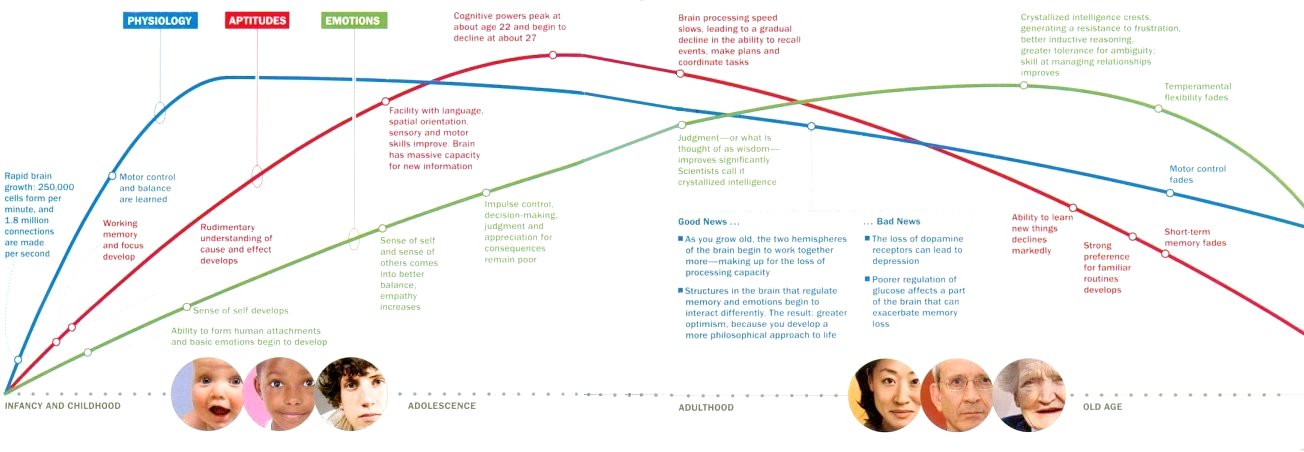 |
Figure 03f The Four Stages of Human Brain [view large image] |
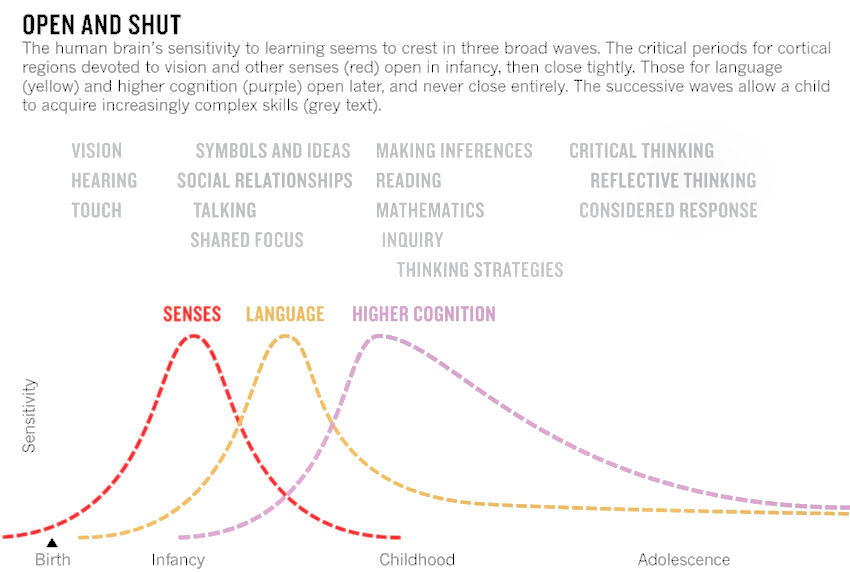 |
which the window of opportunity slams shut, and learning anything new in that realm becomes difficult, if no impossible (Figure 03g). For years, it is assumed that the brain's plasticity, or the ability to learn within the critical periods, was the work of excitatory neurons, which encourage neighboring neurons to fire. Recent study using inhibitory neurotransmitter (such as GABA) indicates that inhibition actually causes the onset of the critical period. It is found that termination of the mental process can be separated into two categories - structural and functional. The former involves physical structures such as neural network and is not easy to change; while the latter is just chemical compounds not difficult to administer. It may be very useful to reopen the critical period later in life. However, no one should |
Figure 03g Learning Curves [view large image] |
tamper the brain's critical periods casually. There is always the possibility of an adverse response, as we break the rule of nature. |
 |
It is well known that the brain is an electrochemical organ; a fully functioning brain can generate as much as 20 watts of electrical power. Even though this electrical power is very limited, it does occur in very specific ways that are characteristic of the human brain. Electrical activity emanating from the brain can be displayed in the form of brainwaves. There are four categories of these brainwaves, ranging from the most active to the least active. Figure 03h is produced by an EEG (ElectroEncephaloGraph) chart recorder to show the different kind of brainwave according to the different state of the brain. These are all oscillating electrical voltages in the brain, but they are very tiny voltages, just a few millionths of a volt. Electrodes are placed on the outer surface of the head to detect electrical changes in the extracellular fluid of the brain in response to changes in potential among large groups of neurons. |
Figure 03h Brain Waves |
The resulting signals from the electrodes are amplified and recorded. |
 |
occur mainly in the parietal and temporal regions of the cerebrum. The Alpha and Theta waves seem to be associated with creative, insightful thought. When an artist or scientist has the "aha" experience, there's a good chance he or she is in Alpha or Theta. These two kinds of brain waves are also associated with relaxation and, stronger immune systems. Therefore, many people try to train themselves to enter such states through various biofeedback7 techniques (with varying degree of success). Delta Waves occur during sleep. They originate from the cerebral cortex when it is not being activated by the reticular formation. In slow-wave sleep, the entire brain oscillates in a gentle rhythm quite unlike the fragmented oscillations of normal consciousness. The neocortical activity is often modulated by a rhythm of 40-80 Hz, called the Gamma wave (not shown in Figure 03h). When there are strong gamma oscillations in certain parts of the neocortex, human subjects do better on learning and memory tasks. A 2010 study indicates that brainwaves are for integrating various sensations to ensure all the relevant signals for one event arrive at the binding site at exactly the same time. This allows the receiving |
Figure 03i Integration of Brain Waves |
neurons to process the signals together, recombining them into a single sensation. For example, we see an apple as red and round, not one red thing and another round thing although red and round are processed by different neuron cells. Figure 03i shows the brain experiences simultaneously many types of brainwaves within its various regions, each performing different functions. |
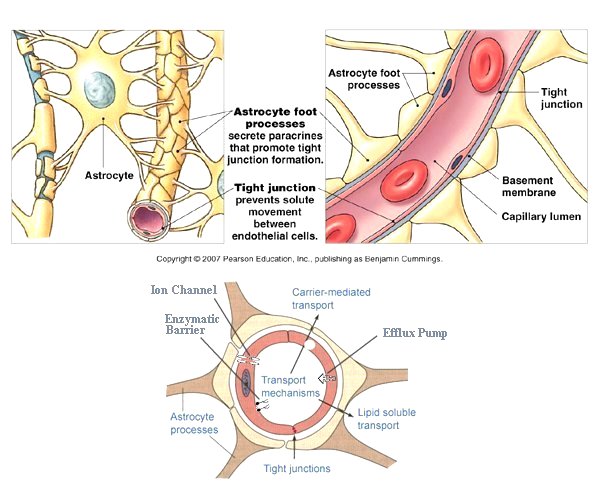 |
With all these delicate components inside the brain, it will not work properly without a critical modification of the capillaries. This is the blood brain barrier (BBB), which prevents harmful substances getting into the brain from the blood. Usually, the capillaries provide a small gap between the endothelial cells (the inner-most layer of cells) to let nutrients and oxygen going into the organs. The gap is large enough for bacteria, and large hydrophilic molecules to escape from the blood vessel causing diseases and other kind of damages to the brain. |
Figure 03j BBB [view large image] |
The special functions provided by the blood brain barrier is summarized below (Figure 03j): |
 |
However, the barrier is not perfect. Harmful substances such as some viruses and bacteria can cross the barrier causing meningitis. The barrier may break down (by radiation, infection, hypertension, etc.) resulting in epilepsy, multiple sclerosis, and Alzheimer etc. The BBB also provide another important function by preventing excessive water and salts into the brain. Since the brain is contained within a rigid, bony skull, the raise in intracranial pressure by leaky blood vessel can be fatal (as in the cases of trauma or infection). Thus, the successful evolution of a complex brain depends on the development of the BBB. It exists in all vertebrates, and also in insects and cephalopod. In human the BBB is fully formed by the third month of gestation, and error in this process lead to defects such as spina bifida (incomplete closure of the embryonic neural tube). It is suspected that leaking of the BBB may play a role in againg and mental diseases. While nature has evolved an elaborate BBB to keep harmful substances out, modern medical technology is trying to break it down at least temporarily for delivering drug to treat diseases ranging from insomnia, depression, to Parkinson and brain tumors. Figure 03k shows some of the techniques to sneak |
Figure 03k BBB Breaching [view large image] |
medications into the brain. Four methods are listed at the bottom. The illustration concentrates on the capillary, which normally carries nutrient to the neuron. |
7The biofeedback technique uses electronics to detect and amplify internal body activities too subtle for normal awareness. One of such methods is the galvanic skin resistance (GSR). It utilizes the fact that skin resistance increases in a calm and relaxed state; it goes the other way at tensing up even slightly. The difference is a reflection of variations in the sweat gland activity and pore size, both of which are controlled by the autonomic nervous system. When the fingers are placed on the sensing plates of the GSR device, the tone lowers with progressive relaxation. The objective is to relax by learning how to diminish the tone of the GSR device to the lowest point possible.