
| Home Page | Overview | Site Map | Index | Appendix | Illustration | About | Contact | Update | FAQ |
| ---------- (6) |
 | ---------- (7) |
 |
u(x) = A cos(kx -  t) ---------- (8) t) ---------- (8)where = 2  , k = 2/ , k = 2/ , and A is the amplitude. The frequency is related to the wavelength and wave velocity by the formula: = v. Figure 03 shows the cosine wave (for A = 1) at two instants of t = 0, and t = /. , and A is the amplitude. The frequency is related to the wavelength and wave velocity by the formula: = v. Figure 03 shows the cosine wave (for A = 1) at two instants of t = 0, and t = /.
|
Figure 03 Cosine Wave |
Note: see footnote  for derviation of the differentiation for the sine and cosine functions. for derviation of the differentiation for the sine and cosine functions. |
 | ---------- (9) |
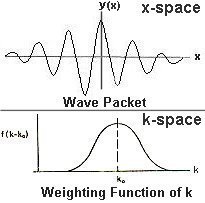 |
where the coefficients An's are replaced by the weighting function f(k - ko), and the sum becomes integration over a continuous range of k from - to + (see Figure 04a). At x = 0 the cosine function is equal to 1, hence all contributions to the integral comes from the weighting function, and the result is large. As x increases, the cosine function becomes a rapidly oscillating function of k, and its integral tends to cancel out resulting in the form of a pulse (wave packet) as shown in Figure 04a. In the limiting case where the weighting function is expressed in term of a delta function - A to + (see Figure 04a). At x = 0 the cosine function is equal to 1, hence all contributions to the integral comes from the weighting function, and the result is large. As x increases, the cosine function becomes a rapidly oscillating function of k, and its integral tends to cancel out resulting in the form of a pulse (wave packet) as shown in Figure 04a. In the limiting case where the weighting function is expressed in term of a delta function - A (k - ko), the wave packet is reduced to the monochromatic form such as shown in Figaure 03 or Eq.(8) with k = ko; the wave is now extending from - to +. In general, there is a certain spreads (k - ko), the wave packet is reduced to the monochromatic form such as shown in Figaure 03 or Eq.(8) with k = ko; the wave is now extending from - to +. In general, there is a certain spreads  x in x, and k in k. In quantum theory, the uncertainty principle postulates that xp > x in x, and k in k. In quantum theory, the uncertainty principle postulates that xp >  =1.054x10⁻²⁷erg-sec, =1.054x10⁻²⁷erg-sec,
|
Figure 04a Wave Packet |
where the momentum p = k comes from the de Broglie formula linking p and . Note: It can be shown that the inverse of Eq.(9) is given by f(k - ko) = (1/ ) y(x) coskx dx, y(x) coskx dx, |
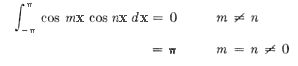
| By virtue of the orthogonality relation: |
 , , |
 |
the cosine function in Eq.(9) acts like an unit vector1 in the 3-dimensional space (Figure 04b), such that in im = nm where i1 = i, i2 = j, and i3 = k, and nm = 1 for n = m; = 0 otherwise. Thus, in quantum mechanics we can consider the wave function in force free space (like the wave packet) as an expansion in an infinite dimensional space with cos(nx) as its bases (unit vectors). Similar expansion can be expressed with wave function in bound states (where n and m become integers) for the cases of non-vanishing potential V(x). The idea has been expanded even further in quantum field theory to the more abstract Fock or Hilbert space, where it is just a mathematical symbol such as |nk im = nm where i1 = i, i2 = j, and i3 = k, and nm = 1 for n = m; = 0 otherwise. Thus, in quantum mechanics we can consider the wave function in force free space (like the wave packet) as an expansion in an infinite dimensional space with cos(nx) as its bases (unit vectors). Similar expansion can be expressed with wave function in bound states (where n and m become integers) for the cases of non-vanishing potential V(x). The idea has been expanded even further in quantum field theory to the more abstract Fock or Hilbert space, where it is just a mathematical symbol such as |nk , where nk represents the number of particles in the state k with certain energy-momentum, spin, ... etc. The corresponding orthogonality relation is now expressed as , where nk represents the number of particles in the state k with certain energy-momentum, spin, ... etc. The corresponding orthogonality relation is now expressed as
|
Figure 04b Unit Vectors (The vector v can be expressed in terms of the unit vectors) |
 nk|nk' = nknk'. In quantum theory, the coefficient or component (such as the f(k-k0) in Eq.(9)) for each of such basis has been identified as the probability amplitude with the state k. nk|nk' = nknk'. In quantum theory, the coefficient or component (such as the f(k-k0) in Eq.(9)) for each of such basis has been identified as the probability amplitude with the state k. |
