| Home Page | Overview | Site Map | Index | Appendix | Illustration | About | Contact | Update | FAQ |
|
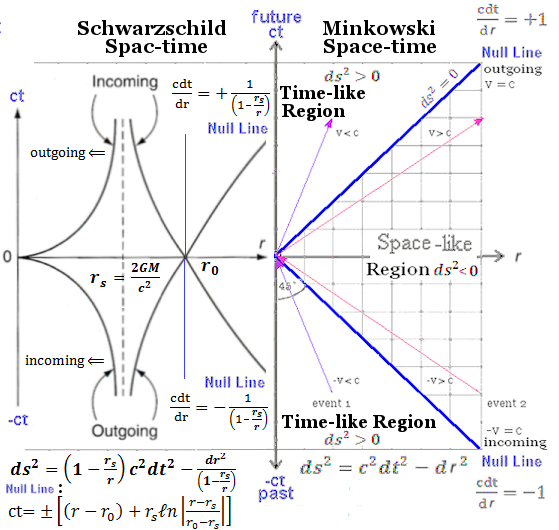
The fate of the collapsing matter in a black hole is supposed to be compressed into a point at infinite density according to conventional wisdom. Other possibilities include : (1) more levels of degeneracy support such as from the quarks (see quark star) or the hypothetical preons (see Preon Star); (2) the unknown effect of quantum gravity, (3) and then the Penrose universes via rotating black hole. Anyway, the Schwarzschild space-time dictates that the event horizon rs separates the space-time into two regions outside and inside rs with distinct properties as shown in Figures 09rd. While the exterior region has found to correspond to many physical features, it is not known if the interior part makes any sense. |
Figure 09rd BH Space-time |
The following is an attempt to introduce quantum effect into the collapse using the Friedmann equation to describe the metric tensor for the interior of the black hole. |
 2 + sin2 d
 2)], where w = sin(k1/2 r) / k1/2 with k >, =, < 0 for closed, flat and open space respectively.
 |dR/dt|. The positive solution represents the cosmic expansion, while the negative one could describe the collapse of matter in a black hole. Starting from r0 = rs, k = 1/(rs)2 Eq.(1b) becomes :
 |
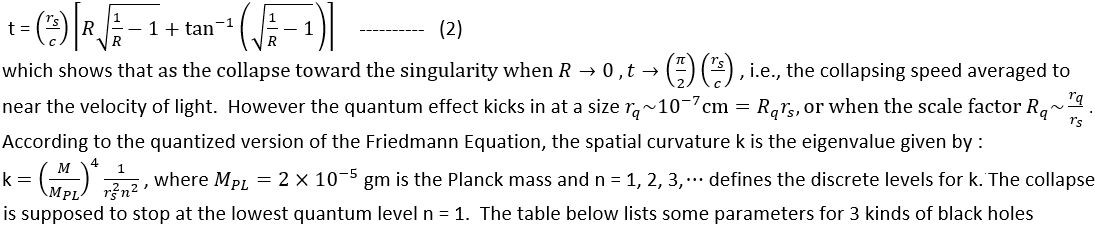 |
Figure 09re Black Hole, Collapse of |
(Figure 09rf). k1 is evaluated with n = 1, the density  1 is estimated by equating to M(k1)3/2. For comparison, the central density of neutron star is ~ 1015 gm/cm3 and ~ 10220 gm/cm3 at the beginning of the inflation period. 1 is estimated by equating to M(k1)3/2. For comparison, the central density of neutron star is ~ 1015 gm/cm3 and ~ 10220 gm/cm3 at the beginning of the inflation period.
|
 |
 where nq = (M/MPL)2(rq/rs) is the quantum number at the classical to quantum matching point, i.e., (1/Rqrs)2 = (M/MPL)4(1/nqrs)2; while kq ~ 1014 cm-2, and tq ~ (rs/c)[(  /2) - (rq/rs)3/2/2] for rs >> rq. /2) - (rq/rs)3/2/2] for rs >> rq.
|
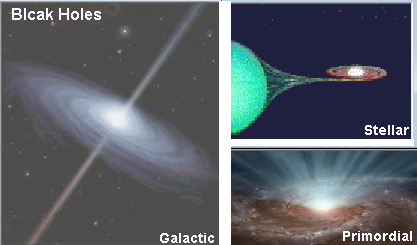
Figure 09rf Black Holes, 3 Kinds [view large image] |
There is a large range of estimated mass for the hypothetical primordial black hole. |
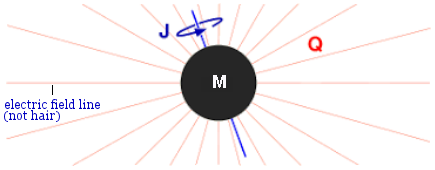 |
between the wave functions of the excited state and the ground state (see example in "QM Basic"). Thus, the collapse may halt at the moment of transition to quantum domain or there is some kind of unknown mechanism that allows the transition to ground state to proceed. Anyway, the derivation up to this point depends on only one independent parameter, e.g., the mass M. The subsequent development and structure follow the specification of just this one variable, no other details are required - the triumph of the "No-hair Theorem" (Figure 09rg) postulated some 50 years ago. |
Figure 09rg No-Hair Theorem [view large image] |
BTW, for a test particle with mass m, the escape velocity is determined by (mv2/2) > (GmM/r) giving v > c inside the region r < rs which is the definition of a black hole, i.e., not even light can escape from inside the region. Thus, such criterion can be derived without referring to the Schwarzschild metric. |