
dQ = TdS +
 dN,
dN,where dS is the change of entropy (randomness),
is the chemical potential associated with the change of state such as phase change etc, and dN the change of particle number in the system.
| Home Page | Overview | Site Map | Index | Appendix | Illustration | About | Contact | Update | FAQ |
|
The change of heat energy dQ can be further specified for isothermal process (where the temperature T = constant, i.e., in equilibrium) as : dQ = TdS + dN,where dS is the change of entropy (randomness), is the chemical potential associated with the change of state such as phase change etc, and dN the change of particle number in the system.
|
Figure 01 Energy of a System [view large image] |
While dW = pdV signifies the change of volume V in response to pressure p. |
 |
|
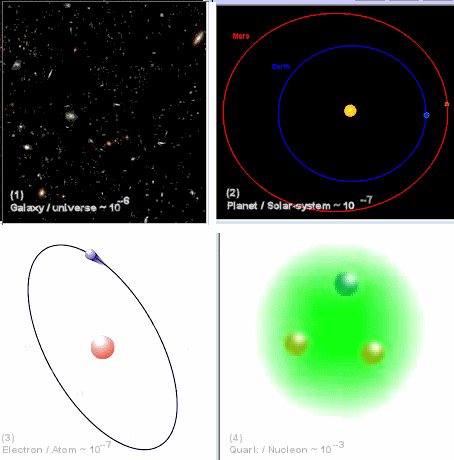
Figure 02 Particle, Definition |
characterized by its electric charge, mass, spin, and color charge. The ratio R ~ 10-3, which is much larger because the strong interaction in this case is a short range force. Actually, not much is known about this system. |
 |
 (m2c4 + p2c2)1/2 for free particle.(m2c4 + p2c2)1/2 for free particle. (m2c4 + p2c2)1/2 for free particle.(m2c4 + p2c2)1/2 for free particle. |
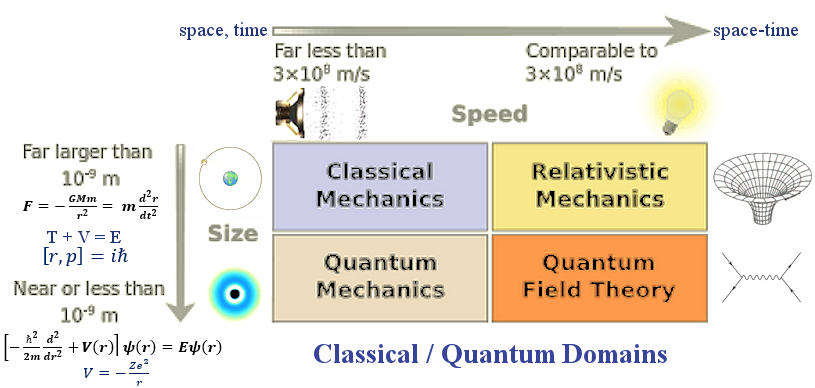
Figure 03 The 4 Domains of Theory [view large image] |
Obviously, the expressions are different between non-relativistic and relativistic theories. |
 |

|
Figure 04 Escape Velocity |
 |
 |
The mainly difference is the existence of two different kinds of charge, i.e., the positive (+) and negative (-) varieties. As shown in Figure 05, like charges are repulsive while opposite charges are attractive to each other. Thus, the letter case behaves the same as gravity with GMm replaced by Qq. In case Q = - q = e (the charge of the electron), Ep = - e2/r. For the case of like charge Ep = + e2/r, there is no bound state (Figure 06). |
Figure 05 Electro-static Forces [view large image] |
Figure 06 Electro-static PE |
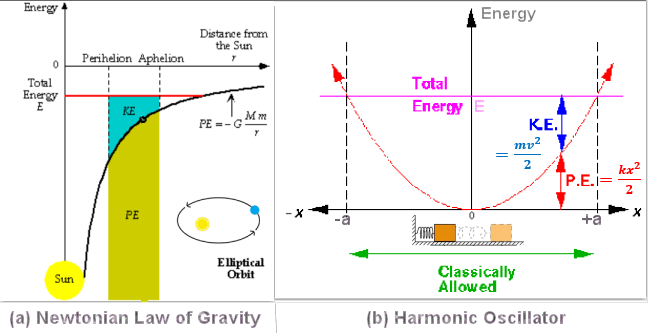 |
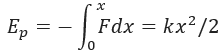 . .Then E = kx2/2 + mv2/2 which would never become negative. Instead, the degree of localization of the particle is determined by the boundary a = (2E/k)1/2, which is obtained by setting v = 0 in E (Figure 07(b)). It also shows the values of Ep and Ek inter-changed between x = 0 and a. The same kind of energies swapping also occurs in planetary motion Between perihelion and aphelion (Figure 07(a)).
|
Figure 07 Potential Curves [view large image] |
 |
|
Figure 08 4-Momemtum [view large image] |
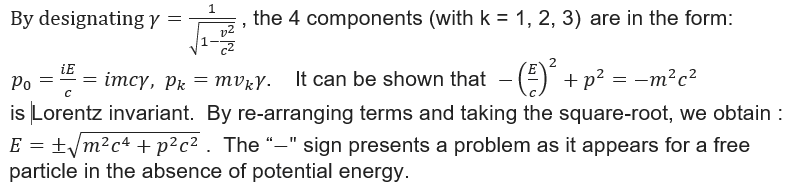
In addition, the velocity of the particle v > c for p2 > |p0|2 with m2 < 0 (Figure 08). It implies that the particle becomes a "tachyon", which does not exist. |
 |
|
Figure 09 Non-relativistic Quantum Mechanics [view large image] |
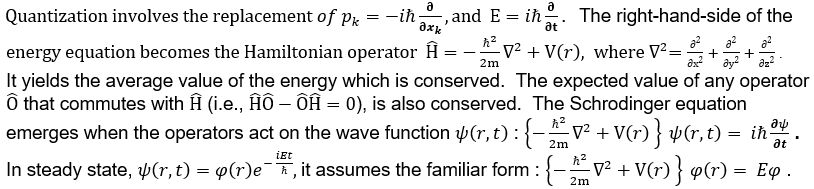
Analytic solutions have been obtained for many potential forms including the hydrogen atom and harmonic oscillator. The novel features include discrete energy level and there is a certain probability for penetrating the boundary (Figure 09). |

 |
p = h/ , ,which can be rewritten as L(cm) = hc/E ~ 4x10⁻⁴/E(ev) (Figure 10). This formula is adopted from telescope resolution, which reveals finer detail with shorter wavelength. The similarity is related to probing the particle structure in scattering experiments, i.e., higher energy of the incident particle can reveal finer detail within. |
Figure 10 Energy/Length Scale |
Note that the energy scale is referred to binding energy for some composite systems such as molecules, atoms, and nuclei. |
 |
Quantum Field Theory (QFT) is devised for studying high energy particle collision. As such, the energy has to be relativistic. The field equation is the starting point for its formulation. The Maxwell's Equations from the era of 1800's are the most ancient one. It is now assigned to cover the photon. The Klein-Gordon Equation for the spin-0 particle (such as the Higg's) was derived in 1926 by quantizing the relativistic energy equation E2 = m2c4 + p2c2 according to the rules mentioned earlier (also see "Klein-Gordon Equation of the Scalar Field"). This formulation avoids the issue of negative energy by using the squared version. In 1928 P.A.M. Dirac tried to resolve the problem with negative energy by splitting the energy equation into two linear forms (see "Derivation of the Dirac Equation and the Weyl Spinor"). The end products are two coupled linear equations, one of which turns out to associate with negative energy in the wave function (see "Interpretation of the Dirac Equation"). He then invented a sea of un-seen particles filling out all the negative energy levels in an attempt to solve the problem. The accepted interpretation now is to identify the negative energy particle with positive energy "anti-particle" moving backward in time (see the colorful illustration below). It is something like treating the -|E| traveling wave exp[(px+|E|t)/ ] = exp{[(px-(-|E|)t]/]} = exp{[px-|E|(-t)]/}. This is known as "Feynman–Stueckelberg interpretation". A lot of questions arise since then about "moving backward in time" like going back to the Jurassic Era (Figure 11) via such mechanism (aka Time Machine). ] = exp{[(px-(-|E|)t]/]} = exp{[px-|E|(-t)]/}. This is known as "Feynman–Stueckelberg interpretation". A lot of questions arise since then about "moving backward in time" like going back to the Jurassic Era (Figure 11) via such mechanism (aka Time Machine).
|
Figure 11 Time Machine |
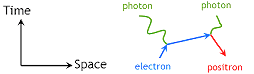  Feynman diagram for electron-positron annihilation. Feynman diagram for electron-positron annihilation. |
 /dt, i.e.,
 |

|
Figure 12 Negative Energy=Anti-Particle, and Backward Time [view large image] |
In this example, the circular orbit is equivalent to the path of the traveling wave, the anti-fermion with charge "-q" and "-t" behaves similarly to a normal fermion. The negative time has no practical significance and can be banished as just a mathematical trick (Figure 12). |
